
By Dr Leena Koni Hoffmann & Dr Leena Koni Hoffmann, Chatham House

Nigeria suffers from endemic corruption. Despite 25 years of attempts at reforms, corruption remains embedded in the country’s institutions and continues to undermine its democracy and economic growth.
Corrupt practices are deeply entrenched across various levels of Nigeria’s government and society. Corruption permeates politics, public administration, law enforcement and the judiciary, often undermining the delivery of basic services.
While most Nigerians disapprove of corruption, many tolerate or even engage in corrupt practices as they see it as the only way of surviving in a dysfunctional system.
This explainer builds on the extensive research of Chatham House’s Social Norms and Accountable Governance (SNAG) project, funded by the MacArthur Foundation, which provides a compelling snapshot of the state of corruption in Nigeria, and the norms and expectations surrounding it.
It explains how Nigeria has been impacted by corruption, how this has informed perceptions of institutions within Nigerian society, and why corruption persists.
How corrupt is Nigeria? Nigeria’s corruption ranking
Globally, Nigeria consistently ranks among the top quarter of most corrupt countries.
Nigeria is ranked among the world’s 40 most corrupt countries on the Corruption Perceptions Index and 35th from bottom on the World Bank’s list of countries measured by their control of corruption. It ranks highly on all four metrics of corruption measured by The Unbundled Corruption Index, with ‘grand theft’ by political elites particularly dominant.
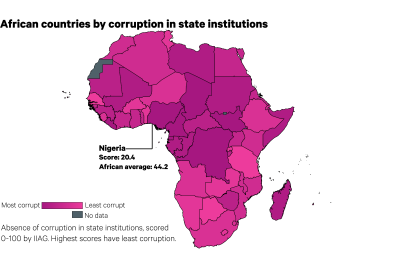
Within Africa, Nigeria ranks 33rd for overall governance out of 54 countries measured in the Ibrahim Index of African Governance (IIAG), which takes into account various measures including anti-corruption mechanisms and how successful they have been. The IIAG places Nigeria well below the average for both the African continent and the region of West Africa.
When measured on the ‘Absence of Corruption in State Institutions’ specifically, the IIAG ranked Nigeria fifth from bottom of the 54 African countries measured.
Effects of corruption in Nigeria
The impact of corruption on Nigerian society is both devastating and multifaceted.
Corruption has eroded the basis for Nigeria’s economic prosperity and negatively impacted its growth. This is evident when looking at Nigeria’s GDP figures. While Nigeria has the fourth largest economy on the African continent by GDP, its GDP per capita – a more accurate measure of prosperity – is among the lowest in Africa.


Corruption continues to be a defining feature of Nigeria’s governance, public administration and political life, hindering its full potential and global standing. At its core, corruption diverts public resources away from vital sectors such as education, healthcare and infrastructure, fuelling poverty and inequality. More than half of all Nigerians – approximately 54 per cent – live in poverty. Related content Taking action against corruption in Nigeria
Beyond the economic wellbeing of Nigeria, corruption has weakened the rule of law and undermines the public’s trust in critical institutions to deliver justice and protect peoples’ lives and basic rights. Such an erosion of trust fosters a culture of impunity, where many individuals believe – rightly or wrongly – that corruption is the reality of life in Nigeria and that many engage in corrupt practices without facing consequences.
This sense of the corruption being intractable has fuelled the frustrations of some marginalized groups and the sense of hopelessness among some of Nigeria’s youth. These grievances, in turn, drive emigration, protests, political violence and even fuel extremist insurgencies.
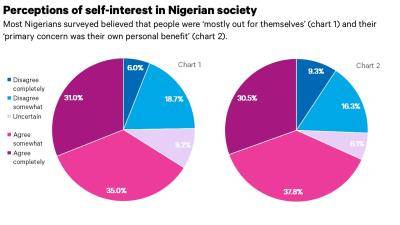
Corruption also impacts social cohesion and national unity. The persistent impunity surrounding corruption also risks eroding ethical values and encouraging a culture of self-interest, where both elites and ordinary citizens increasingly prioritise private gain over the collective good. This has exacerbated Nigeria’s societal challenges, perpetuating a vicious cycle of corruption, systemic inefficiencies and underdevelopment.
What do Nigerians think about corruption and its impact?
While Nigeria suffers from extensive corruption, extensive research by Chatham House and others shows that Nigerians largely oppose corruption and acknowledge its harmful effects on the country.
Survey data between 2016 and 2023 shows Nigerians consistently believe corruption is both common and wrong. This applies across different types of corruption, ranging from petty corruption such as bribery to state-level embezzlement.
For example, more than 88 per cent of Nigerians said they thought it was unacceptable for a police officer to ask for a bribe in 2023 – up slightly on 87.8 per cent when surveyed in 2016. Most Nigerians surveyed in 2022 also said they disapproved of judicial bribery (88 per cent), contract inflation (85 per cent) and the diversion of contract funds (88 per cent).
88% of Nigerians said they thought it was unacceptable for a police officer to ask for a bribe in 2023.
Likewise, separate Chatham House research has demonstrated that most Nigerians think vote-selling is unacceptable, even while they acknowledge it is widely prevalent.
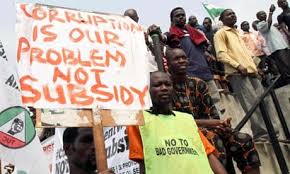
The public’s disapproval of government corruption has contributed to mass protest movements. These include the 2012 ‘Occupy Nigeria’ movement, which was sparked by the removal of fuel subsidies – which were seen as benefiting allegedly corrupt officials and multinational corporations – but was underpinned by wider discontent with corruption.
Likewise, young Nigerians called for accountability as they protested against police brutality and extortion in the #ENDSARS protests of 2020. In 2024, Nigerians took to the streets again to protest against poor governance and corruption.
Do Nigerians trust the police, the government or religious leaders?
The prevalence of corruption has contributed to a crisis of trust in Nigeria’s institutions and society.
Chatham House’s survey data shows a substantial proportion of the population distrust key institutions. Governance and law enforcement institutions are the most distrusted: Nigeria’s police force has the lowest level of trust, highlighting deep-seated challenges related to corruption, abuse of power and lack of accountability.
Lower trust in governance institutions (i.e. federal, state and local government) also reflects concerns over the efficiency and transparency of government spending and most citizen’s experiences with inadequate public services. The crisis of trust in Nigeria’s justice system is a stark indictment of compromised courts, which are widely perceived as politically captured and therefore unable to guarantee impartiality and equitable access to justice.

On the other hand, religious institutions in Nigeria enjoy the highest level of trust, reflecting the significant influence and respect religious figures hold in Nigerian society. Traditional leaders also command a relatively high level of trust, indicating the enduring importance of cultural and customary authority in many communities across the country.

Do Nigerians trust their neighbours?
While Nigerians may have a crisis of trust in governance structures, and to a lesser extent religious and traditional leaders, they are much more likely to trust their neighbours.
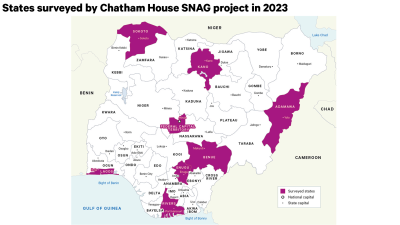
This is evident in the latest SNAG survey results. For example, a majority of Nigerians (66.2 per cent) believed it was at least moderately likely that a lost bag with valuables would be returned by a neighbour. This was particularly high in Kano and Benue in northwest and central Nigeria respectively, indicating a strong belief in the honesty and helpfulness of neighbours there. The lowest levels of trust in neighbours were found in Enugu, a key state in the South-East. There were also low levels of trust in Lagos, Nigeria’s commercial centre in the South-West, and Rivers, an important political and oil producing southern state.

More broadly, Nigerians showed mixed levels of trust in others. When asked whether they think most people can be trusted, more than half of respondents in the latest SNAG survey said they did not – 17.9 per cent said ‘not at all’ while 40.8 per cent said ‘not much.’ Only 41.3 per cent had higher levels of trust: 35.5 per cent said ‘to some degree’ and only 6.1 per cent said ‘a great deal’.
Why do people in Nigeria put up with corruption?
Despite the SNAG survey results showing there is widespread disapproval of corruption in Nigeria, many Nigerians tolerate or even engage in corrupt practices as a means of survival or achieving upward mobility in a dysfunctional system. A significant factor contributing to this tolerance is the perception that corruption is the price for getting things done, and there is little to no consequence for wrongdoing.
While most Nigerians disapprove of corruption, many tolerate or even engage in corrupt practices as they see it as the only way of surviving in a dysfunctional system.
Moreover, the culture of clientelism and patronage prevalent in Nigeria has normalized corrupt practices. Social connections, family ties, and political allegiances often play a significant role in determining access to resources and opportunities. In this environment, individuals can feel pressured to engage in corrupt practices to maintain relationships and secure their position within the social hierarchy. The result is a complex web of dependence and obligation that perpetuates corruption, even among the many who disapprove of it in principle.
In a society where basic services are often unreliable and access to opportunities limited, individuals may resort to bribery or other corrupt acts to secure essential services, navigate bureaucratic hurdles, or gain an advantage in the marketplace. The limited enforcement of anti-corruption laws and the impunity enjoyed by powerful individuals further reinforce the perception that corruption is a risk-free endeavour if you have the right connection. In sharp contrast, being honest and ‘doing the right thing’ is often costly and unrewarded.
Why does corruption persist in Nigeria?
Corruption persists in Nigeria because of a complex interplay of systemic factors, including weak institutions, compromised governance structures, and deeply ingrained social norms. The World Today Related content How to help Nigerians who want to act against corruption
Decades of military rule, the weakness and stymied development of democratic institutions and unaccountable leaders have created a fertile environment for corruption to thrive.
Insufficient funding for anti-corruption agencies, coupled with political interference, has also undermined the effectiveness of key institutions that were established or reconstituted after the end of military rule 25 years ago. As a consequence, some officials can act with impunity, protected by their powerful patrons and offering protection to loyalists and allies.
How to tackle corruption in Nigeria
Corruption may appear to be inevitable in Nigeria. But it doesn’t need to be. Despite widespread recognition that corrupt practices are deeply entrenched, Nigerian people’s belief in interpersonal and community trust offers a hopeful foundation for change.
Motivated anti-corruption reformers are hard at work within Nigeria and have shown they can mobilize popular support for change at different levels of society. These efforts, led by credible and trusted leaders, can build strategic coalitions within government, civil society and business. Related content Independent Thinking: How can Nigeria tackle corruption?
Examples include Accountability Lab Nigeria’s ‘Integrity Icon’ initiative, which recognizes ethical public officials, or the School of Politics, Policy and Governance, an unconventional academy that aims to produce a new generation of reform-minded and ethical leadership.
But to achieve this at the national scale, much more work is needed to better coordinate and support credible individuals and groups to challenge the status quo, capitalize on anti-corruption reform opportunities and bring about change in ways that are perceived as locally legitimate and sustainable.
Dr Leena Koni Hoffmann is Associate Fellow, Africa Programme while Tommy Hilton is Comment Editor, Communications and Publishing, Chatham House