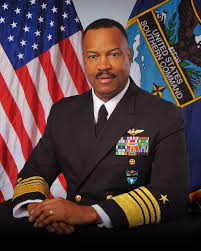

- Admiral Holsey, who is Black, joins a line of roughly a dozen military leaders under Hegseth — many of whom non-white or women — who have been either fired from their posts or who have stepped away early.
Adm. Alvin Holsey, the top commander who oversees U.S. military operations in Latin America, announced he will retire in two months after just over a year on the job. The surprise announcement comes amid U.S. attacks on boats in the Caribbean and escalating tension between the U.S. and Venezuela.

Admiral Holsey, who previously served as SOUTHCOM’s military deputy commander and is Black, joins a line of roughly a dozen military leaders under Hegseth — many of whom non-white or women — who have been either fired from their posts or who have stepped away early.
With his exit, African Americans now have one of their own in command of the United States Department of Defense operates 11 unified combatant commands (CCMDs). They were three when Trump was sworn in on January 21, 2025. But the first to go was the US Africa Command (AFRICOM) Commander, Marine General Michael E. Langley, now followed by Admiral Holsey. The only Black in charge of one of the 11 CCMDs is the US Strategic Command (STRATCOM) Commander, General Anthony J. Cotton.
Defense Secretary Pete Hegseth announced Holsey’s departure on social media Thursday afternoon. U.S. Southern Command released a statement from Holsey about an hour later, in-part stating that the command “has made lasting contributions to the defense of our nation and will continue to do so.”
Neither official gave a reason for the departure, and a spokesperson for the Pentagon said they did not have any additional information beyond Hegseth’s post. The spokesperson did not say who would replace Holsey. The SOUTHCOM commander role is typically held by a four-star general or admiral for around three years. Holsey was confirmed to the role and promoted to four-star rank in November.
“It’s been an honor to serve our nation, the American people and support and defend the Constitution for over 37 years,” Holsey said in the statement. Hegseth said that Holsey “has demonstrated unwavering commitment to mission, people, and nation” and his tenure at SOUTHCOM “reflects a legacy of operational excellence and strategic vision.”
Holsey commissioned into the Navy in 1988 through the Naval Reserve Officers Training Corps program at Morehouse College, according to his official biography. A pilot, he flew the SH-2F Seasprite and the SH-60B Seahawk helicopters. He served as the director of Task Force One Navy in 2020, an organization meant to “address the issues of racism, sexism and other destructive biases and their impact on naval readiness,” according to the sea service. He also served as the commander for Carrier Strike Group One and as the first commander of the International Maritime Security Construct / Coalition Task Force Sentinel.
Escalating attacks around Venezuela
The atypical announcement comes after more than a month of escalatory U.S. military operations in the Caribbean and as the Trump administration ratchets up pressure on Venezuela’s president, Nicolas Maduro, who is considered an authoritarian figure.
Since the beginning of last month, the U.S. military has struck at least five boats off the coast of Venezuela in what it says is an escalating counter-drug operation against smugglers. The strikes have killed 27 people, which has drawn a litany of criticism and speculation as to the legality of the attacks.
President Donald Trump — who said that the U.S. was now in “a non-international armed conflict” with drug cartels — has leaned on his powers under Article II of the Constitution (after his administration labeled the cartels as foreign terrorist organizations) to conduct these strikes, sidestepping Congress.
On Wednesday, Trump confirmed that he had authorized CIA operations in Venezuela shortly after The New York Times reported it. CBS News reported that the military flew three B-52 bombers near Venezuela the same day Trump confirmed the CIA authorization. He said alleged drug smuggling and “empt[ying] their prisons into the United States of America” from the South American country was justification for the spy agency’s involvement.
“This is going to go on,” said Mark Cancian, a retired Marine colonel and senior adviser with the Center for Strategic and International Studies, in an interview with Task & Purpose on Thursday said of the military operations. “This has now become routine, there’s going to be additional attacks on alleged drug vessels.”
He said he is watching U.S. force levels in the region, reportedly around 10,000 personnel as of this week.
“So far, they haven’t gone down,” Cancian said, though noted that while the surge is enough to create an “intimidation factor” it is not likely enough for an invasion. “This thing’s going to be around for a while and with every ratchet, the possibility of some sort of kinetic action increases.”
Written with reports from Task & Purpose