
By Group Captain Sadeeq Garba Shehu (rtd)

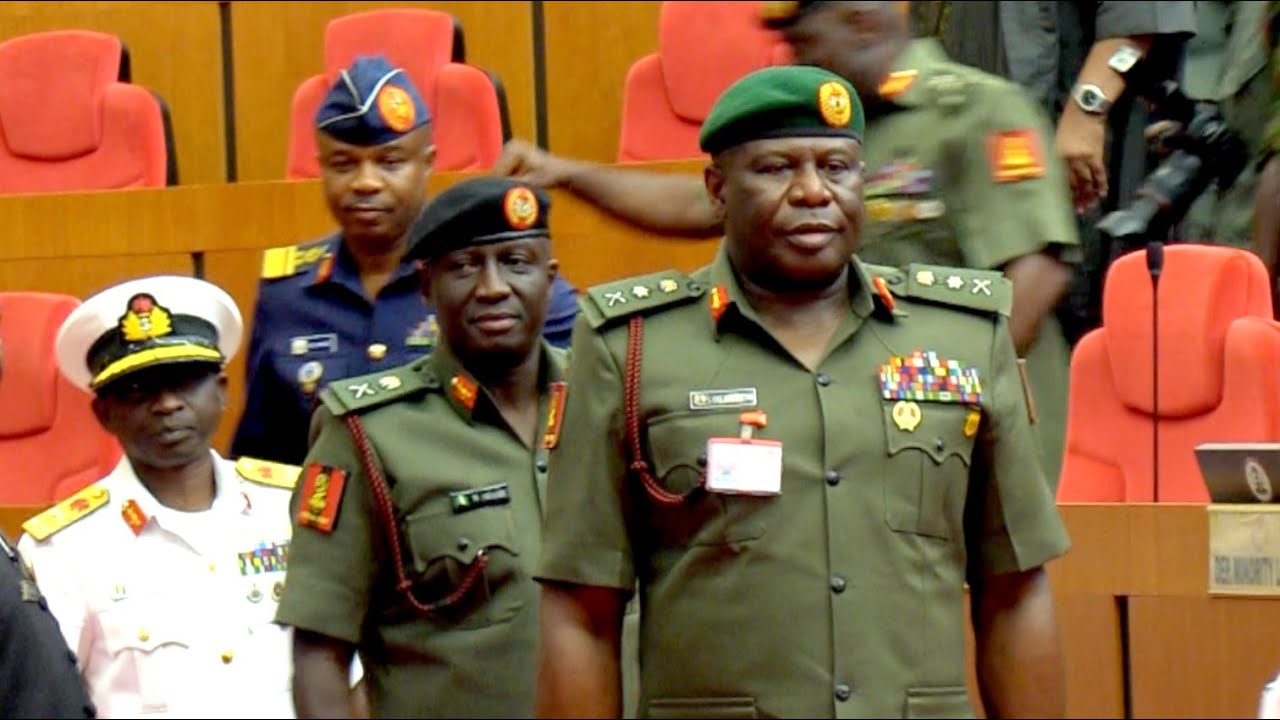
When the newly nominated Service Chiefs appeared before the Nigerian Senate for confirmation, an understated but profound drama unfolded in the chamber. Each officer, immaculately turned out in uniform, paused before the mace, bowed to the Senate President, turned to both flanks of the chamber, and again bowed respectfully before taking the podium. To most citizens, this was mere politeness. Yet to the trained military eye like ours, steeped in military customs and traditions, it revealed a deeper question of civil–military protocol, symbolism, and institutional identity.
Brigadier General Sani Kukasheka Usman (rtd) has thoughtfully reopened this debate in his recent essay, “Military Courtesy and Civil Authority: Rethinking Salutes and Bows in Nigeria’s Parliamentary Screenings.” His argument is deceptively simple: while uniformed officers owe full respect to civilian authority, that respect should be rendered through the language of their profession — the salute — not the bow.
BETWEEN THE BOW AND THE SALUTE
The distinction is not semantic. In military culture, the salute is a codified expression of honour, discipline, and allegiance to the state. It is never arbitrary; it is rendered with headgear on, under defined circumstances, and signifies equality of respect among comrades as well as submission to lawful authority.
The bow, by contrast, is a civil or parliamentary courtesy — a gesture of humility within legislative custom. When a uniformed officer bows in a civilian chamber, the act risks being misconstrued as personal obeisance rather than constitutional respect.
In mature democracies such as the United Kingdom or the United States, service chiefs entering Parliament or Congress acknowledge the Chair with a nod or verbal courtesy; there is no ritual bowing and no indoor saluting. Nigeria’s current hybrid practice, inherited partly from the civil service and partly from colonial formality, (or even partly from confusion due to lack of official policy guidance) therefore falls somewhere between both worlds — respectful but ambiguous. Neither here nor there.
RESPECT WITHOUT SUBSERVIENCE
True democratic civil–military relations require deference without loss of professional identity. Civilian supremacy over the armed forces is a constitutional principle; but the means of expressing that respect should remain consistent with military decorum.
When a General salutes the legislature, he salutes not an individual Senator but the sovereignty of the Republic which the National Assembly represents. In that sense, the salute is a declaration of fidelity to the Constitution, while the bow may suggest mere compliance with political ritual.
WHY WE NEED A CODIFIED PROTOCOL
Symbols shape perception. In an age when Nigerian democracy is still negotiating the delicate balance between civilian oversight and military professionalism, clarity in protocol can prevent misunderstanding. The military is a profession of SOPs and checklists and procedure. Which is why as soon as you join you are taught how to dress your bed, how to shine your shoe, the exact way to lace your boots, the dimension and shape of your moustache and if a female the kind of hairstyle you must adopt…
This is why the @Armed Forces of Nigeria, Defence Headquarters Nigeria, HQ Nigerian Army, Nigerian Navy, Nigerian Air Force HQ need a jointly issued “Protocol on Military Courtesy in Civilian Settings” — developed in conjunction with the National Assembly – Nigerian Senate, House of Representatives of the Federal Republic of Nigeria – which could define how military officers appear before legislative bodies, judicial panels, or commissions of inquiry.
Such codification would:
a. Preserve decorum and hierarchy in public proceedings.
b. Prevent the erosion of military culture through unstructured mimicry of civil service habits.
c. Reinforce mutual respect between institutions without theatrics without confusion or adhocracy.
BALANCING TWO LANGUAGES OF AUTHORITY
The legislature is a deliberative institution; the military is a disciplinary one. Each possesses its own grammar of authority. What strengthens democracy is not the blurring of these languages but their harmonisation through understanding. When senators recognise a formal salute as the military’s highest expression of respect, and when officers understand that the salute affirms civilian supremacy, both sides win.
A LESSON IN DEMOCRATIC MATURITY
As @Brig Gen Usman Kukasheka Rtd reminds us, this issue is not about etiquette; it is about identity and symbolism. Nations are built not only by constitutions but also by the small rituals that express who commands, who serves, and how respect is exchanged. Codifying the salute in legislative appearances would send a quiet but powerful message: Nigeria’s armed forces are professionally distinct yet democratically loyal.
The next time a Service Chief walks before the Senate, may he stand tall, salute the mace of the Republic, and take questions with confidence — not as a subordinate bowing for favour, but as a public servant reaffirming that enduring covenant between the sword and the law.
The duty of retired military officers is to remind the serving ones, to preserve and not dilute military culture. When they err, we remind them. We wince painfully when we see an officer walking without headgear. We wince when we see a General dancing in uniform.
Group Captain Sadeeq Garba Shehu (rtd) is a Security & Defence Analyst/Conflict Security & Development Consult Ltd