
Former Chief of Army Staff (COAS) and ex-Minister of Interior, Lieutenant General Abdulrahman Bello Dambazau (rtd) on Tuesday gave insight into the factors worsening Nigeria’s security crisis, blaming it on weak governance and corruption by executive and legislative arms of government, inadequate welfare for security personnel, insufficient coordination among security agencies and underdeveloped criminal justice institutions.

General Dambazau, who is the pro-chancellor of Capital City University, Kano, also blamed limited legislative oversight, inconsistent enforcement of law and order, an overstretched military, misallocated police resources, underutilized civil defence units, and the absence of a comprehensive strategy for rural security for exacerbating the security situation in the country.
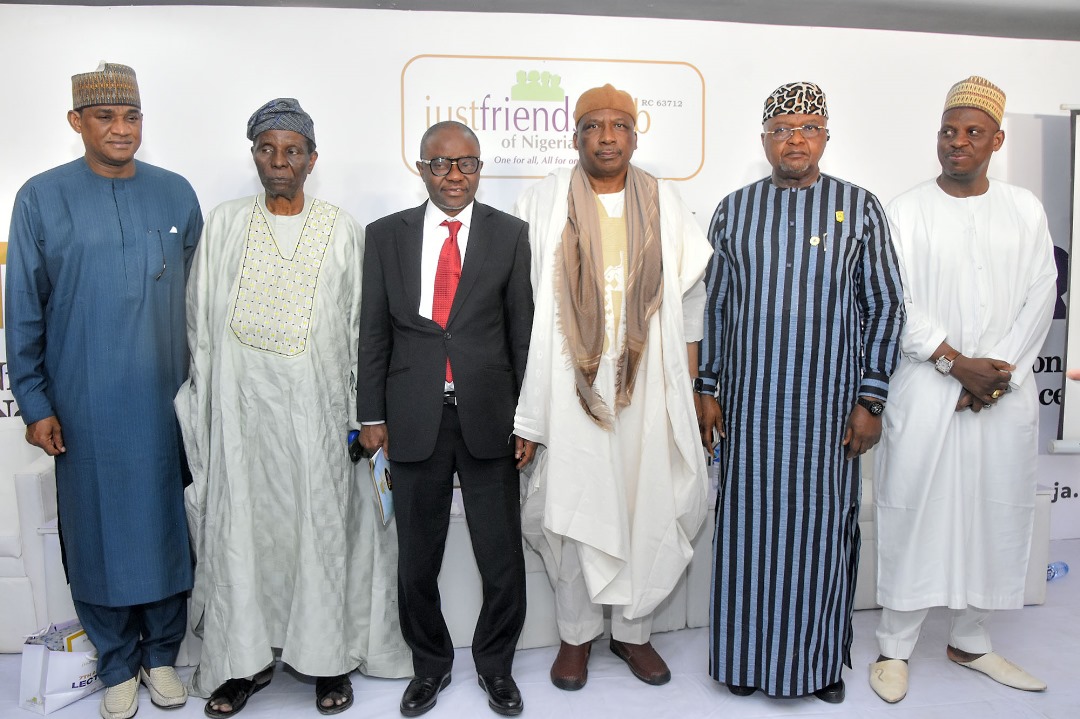
Dambazau spoke in Abuja at the seventh annual public lecture of the “Just Friends Club of Nigeria” (JFCN) during a keynote address on “Nigeria’s Security Challenges and the Quest for National Cohesion: A New Paradigm for Internal Security Architecture and Governance,”
Tracing the origin of the Boko Haram insurgency in Maiduguri, Borno State to a local law enforcement failure by the Nigeria Police in 2029, the former COAS said: “Boko Haram started as a local issue triggered by a law on wearing crash helmets. Some of Yusuf’s followers were stopped by the police while heading to a burial because they were not wearing helmets. A fracas ensued, and the police shot a few of them. Mohammed Yusuf swore revenge, and weeks later, they began attacking police stations.
“I was in China when I was informed of the order (by then-President Umaru Musa Yar’Adua, ordered a military operation) to clear their enclave. After the operation, we arrested Mohammed Yusuf and many of his followers. As military personnel, we handed them over to the police as required.
“Unfortunately, the police executed Yusuf in front of the camera, and the footage spread worldwide. Those who escaped used the images to attract sympathy and recruit followers. That was the real beginning.”
He also regretted that the “policing the environment has been militarized, with law enforcement agencies wielding assault rifles in public, which often scares the people they are meant to protect. Ordinarily, policing agencies are to use non-lethal force when enforcing law and order, but our situation today is such that non-state actors are equally armed while carrying out their criminal activities. The monopoly of violence or the use of force is no longer the peculiarity of government-policing agencies.”
General Dambazau added that “current police priorities appear to centre on VIP protection and other significant individuals, which may compromise overall law enforcement efforts. Factors such as these distractions, along with politicization, have contributed to calls for the establishment of state police. The challenges facing the Nigeria Police include a lack of professionalism resulting from inadequate leadership, training, discipline, equipment, welfare provisions, and corruption.
Consequently, there is a deficit of public trust and confidence in both the police and the Department of State Services (DSS), with allegations relating to limitations on civil liberties and human rights violations. While police resources are misapplied and misused, civil defence resources are underutilized. This raises the question of why the government is keen to create the so-called forest guards, a situation that will further thinly split the resources.”
He canvassed for the modernizing and reforming of the security sector as “militarization of the security environment; lack of capacity to protect communities; over reliance on military force; misuse of police resources; focus on regime security; shift in warfare; and protection of civil liberties and human rights are a few of the reasons why we need this reform and modernization. Efforts have been in the past to reform the security sector and it is important to refer to them.”
Turning to the current wave of banditry in the North West region of the country, Dambazau said it resulted from years of neglect, poverty, and governance failure.
“You cannot solve insecurity with bullets alone. The roots of banditry lie in unemployment, hunger, lack of education, and weak local administration,” he said. “The military has been overstretched because the police, who should handle internal security, are underdeveloped and politicised.”
He criticised the growing use of soldiers for routine policing, saying it had eroded their constitutional role of defending Nigeria’s territorial integrity.
“The military is now everywhere doing roadblocks and checkpoints. That’s not their job. Meanwhile, governors keep building roads but neglect education and healthcare, which are the real foundations of human security,” he added.
Dambazau also accused both the executive and legislature of mismanaging security funds, noting that despite huge annual allocations, insecurity persists due to leakages and misplaced priorities.
“Many items in the defence budget are contractor-driven and inserted by lawmakers without consulting the services. Sometimes, the items are irrelevant to operational needs,” he said, adding that barely 40 percent of most approved security budgets are released.
He stressed that “investment in the military alone will never solve Nigeria’s problem if we do not invest in people.”
Dambazau dismissed recent Western narratives alleging genocide against Christians in Nigeria, describing them as propaganda aimed at manipulating global perception.
“America protects its own interests, not anyone else’s. Nigeria must define and defend her own interests,” he declared.
Also speaking, former Chief of Policy and Plans at the Nigerian Air Force, Air Vice Marshal Gbolahan Adekunle (rtd), lamented the demoralisation of security personnel and the waste of training resources due to premature retirements.
“It costs about $114 million to train one officer for strategic-level deployment, yet within six years, many are retired. That’s how we lose our best hands,” he said.
He recalled a 2024 incident in Gwoza, Borno State, where three radicalised teenage girls detonated bombs in a public place, stressing that “we are fighting an enemy that operates in the minds of our children.”
A Professor of Strategic Management at Nnamdi Azikiwe University, Okey Ikechukwu, said the disconnect between government and citizens had weakened public intelligence cooperation.
He faulted the tendency to blame the military while ignoring failures of civilian leadership and noted that the global arms trade continues to fuel conflicts in Africa.
President of JFCN, Fred Ohwahwa, expressed concern over recent threats by U.S. President Donald Trump to invade Nigeria, urging citizens to confront insecurity decisively to prevent foreign interference.
He reaffirmed the club’s commitment to promoting national dialogue, civic responsibility, and collective engagement in addressing Nigeria’s pressing challenges.
The lecture was chaired by former Director-General of the Nigerian Television Authority (NTA), Professor Tonnie Iredia.