
By Abubakar Adam Ibrahim

At the end of its run, Game of Thrones concluded with a whimper. But at its peak, it provided one of the most iconic discourses on power in Season Two, Episode One, where Cersei Lannister, the Queen, and Littlefinger, the spymaster, exchange words. Littlefinger argued that knowledge is power because he had information about the queen that she wouldn’t want made public. Cersei, the cunning queen, aptly ordered her guards to seize him and slit his throat, which they were about to do before she commanded them to stop. She then asked them to free him and gave them a few more orders that they obeyed without question before proclaiming to the shaken man that “Power is power.”
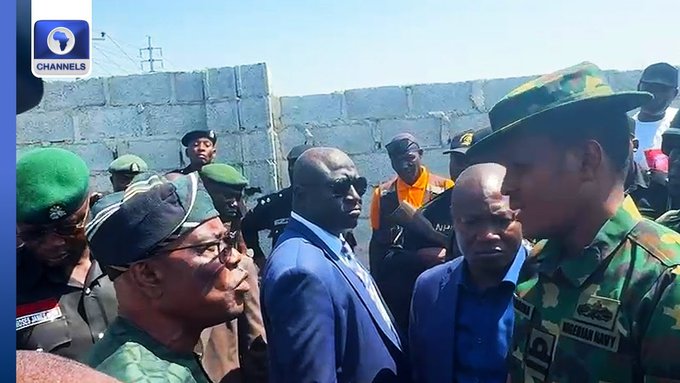
Wike’s altercation with the naval officer, Lt. AM Yerima, on Tuesday brought this scene to mind. It was a scenario that should not have arisen if the law had been duly followed. However, it was an encounter that provides an opportunity to highlight some of the issues related to our use and abuse of power.
For one, there are attitudes and behaviours we have internalised over the years to navigate everyday conflicts. At the heart of the fracas was the concept that might is right, which has been plaguing Nigeria for years.
As the FCT Minister, Nyesom Wike has the legal authority to revoke the ownership of any land in the FCT and assign it as he wishes. That is not in question here. However, it could be argued that the Honourable Minister has stretched this power to the extreme by unleashing a wave of land revocations in the capital.
This would not be the first time Wike has overextended his powers. In 2016, while governor of Rivers State, Wike physically blocked officers of the Directorate of State Services (DSS) from performing their legal duties when they attempted to raid the Port Harcourt residences of judges suspected of corruption and complicity in electoral fraud. Wike at the time called the DSS’s actions impunity and prevented the officers from executing their duty. Granted, it is not on publicly available record that they had any warrants to carry out those operations because the DSS has also been known to operate with impunity when it suited them.
If an argument could be made that Wike was right to intervene at that time, could the same argument be made about the manner in which he interfered with the tenure of his successor, Siminalayi Fubara, whom he openly threatened with impeachment, resulting in Fubara being suspended from office for six months? Wike was brazen in his quarrel with Fubara, ignored legal precedents, and used his power to oust a sitting governor elected by the people of the state.
Given his history of unabashed and sometimes caustic displays of power, it is no surprise to see Nigerians gloating over his very public confrontation with a young military officer who refused to yield to the minister’s presence and threats.
Nigerians, desperate to find heroes, celebrated Lt. Yerima of the Nigerian Navy, not only for his uprightness in standing his ground against what they considered attempts at intimidation by the minister but also overlooked the misuse of power on both sides that led to the confrontation. While one may not fault Officer Yerima for his composure and professional conduct, the misuse of power within the institution he represents, which placed him in that conflict, should concern us.
Yerima was acting on orders from his superiors; that is what he was trained to do. Nowhere in the code of his service was he instructed to take orders from Barr. Wike, as the Minister was not his superior or commanding officer. Wike may rank higher than the Chief of Defence Staff as a Minister of the Federal Republic, but nowhere in the constitution does that authorise him to command troops. If he could use his power and position in the government to have Yerima’s superior issue a new order to the soldier, that would be a different scenario. However, asking the soldier to contravene a direct order from his commanding officer is a misapplication of his power and a refusal to recognise the chain of command in the military and the soldier’s professional role.
In truth, there may be no problem with Yerima standing his ground, but there is a problem with him and his colleagues being there in the first place, and that is through no fault of his. Why the military is being deployed to guard parcels of land that are private property is what we should be questioning.
This was how a soldier attached to a senior military officer was assigned to chase thieves attempting to steal chickens from the officer’s farm. The pursuit resulted in an accident that left the soldier badly injured and effectively ended his military career. Instead of dealing with Boko Haram and other existential threats plaguing our country, we lost a soldier chasing chicken thieves, a task that private guards or the police should be handling. That was not what that young man signed up for.
Since the military’s incursion into civil spaces in 1966, we have had to contend with the consequences of this incursion, not only in the political sphere but also in private disputes. Often, soldiers have been called into land disputes, private fights, and even domestic altercations. The militarisation of Nigeria, through these interventions and the abuse and corporal punishment the military has imposed on our civilian population, has solidified into a national culture. This culture has persisted beyond the military’s presence in the political sphere.
It has been so ingrained in Nigerians that even politicians, thanks to access to power and resources, have adopted a militaristic approach to governance when convenient. This is often seen through the habitual use of brute force when nuance and dialogue could suffice, particularly when dealing with dissent, opposition, or contesting elections, or even in the adoption of abrasive and crudely assertive language instead of a courteous one.
When Wike, for instance, was saying to the soldier, “You are a fool,” and “Shut up there!” it is clear that there is a recognition that the tonality and diction stem directly from the military culture of speaking. This is the language of power, Nigerian style.
As Pierre Bourdieu, the renowned French sociologist and public intellectual, explained, power reproduces social hierarchies through internalised practices and cultural capital. One aspect of that cultural capital is language, and given how the military has deployed and weaponised it against Nigerians, those aspiring to power and authority have internalised this discourse style.
Power, Bourdieu argues, operates by shaping perceptions and classifications that are accepted as legitimate, often invisibly reinforcing social hierarchies. It is relational and tied to material and symbolic capital within social fields.
In this case, both the soldier and Wike have differing ideas of who holds the power. For a soldier raised by an institution with a history of subverting democratic institutions, assassinating, arresting, detaining, and tormenting politicians, there are also attitudes that are internalised and passed down. Yerima might have been professional and courteous, even if firm, in his interaction, but that is the institution he represented and from which he drew his authority—an institution whose rhetoric since the incident seems to endorse the soldier’s actions.
When considered, these confrontations highlight our attitudes toward power: who has it and who can deploy it. Having one form of power does not exempt one from the reach of another, as Littlefinger from Game of Thrones discovered when Cersei ordered her boys to put a knife to his throat.
It is fortunate that this Wike vs. Yerima encounter did not turn out worse, given all those guns, testosterone, and the men carrying them desperate to impress their ogas.
But as Nigerians lionise a new hero for standing his ground against a minister, we should also question a system that has allowed some of our finest soldiers to be deployed to guard their CO’s chicken farms, their wives or concubines, or plots of land when the country is practically at war. The military must be unshackled from these civilian entanglements to effectively carry out their duties.
As a matter of urgency, we must demilitarise our politics and civic culture by deliberately extricating soldiers from civil spaces, training and expanding the police to fulfil their duties, because their failures create a vacuum that the military is always invited to fill. Above all, we must favour decorum in our interactions. Engagements should not be defined by whose ego is bruised, who has the bigger balls or by a do-you-know-who-I-am mentality.
Abubakar Adam Ibrahim, a columnist with Daily Trust, can be reached through abubakaradam@dailytrust.com
Twitter: @Abbakar_himself
WhatsApp: 08020621270