

By Group Captain Sadeeq Garba Shehu (rtd)

In principle we operate American style presidential democracy. As someone familiar with how American-style democracies structure their defence and national-security architecture, I find it necessary to highlight a worrying Nigerian practice that has quietly become normalised — but is deeply abnormal, unprofessional, and institutionally dangerous.
In the United States, the President is briefed through structured, institutional channels:
Director of National Intelligence (DNI) → Intelligence
CIA Director → Threat assessments, covert operations
Secretary of Defense → Civilian oversight
Chairman, Joint Chiefs of Staff (CJCS) → Military advice
National Security Advisor (NSA) → Coordinates all inputs
All operating within the National Security Council (NSC) framework.
Crucially, the U.S. President does NOT meet service chiefs directly without the civilian Secretary of Defense present. That would violate the principle of civilian control and proper chain of command.
NIGERIA’S GROWING BAD HABIT : Direct Access of Service Chiefs to the President
In Nigeria, however, a disturbing pattern has become entrenched:
When the new set of Service Chiefs were nominated, even before Senate confirmation, we saw them meeting the President ALONE, without the supervising Ministers of Defence.
A few days later, the new Chief of Army Staff again went to brief the President ALONE, bypassing the Ministers.
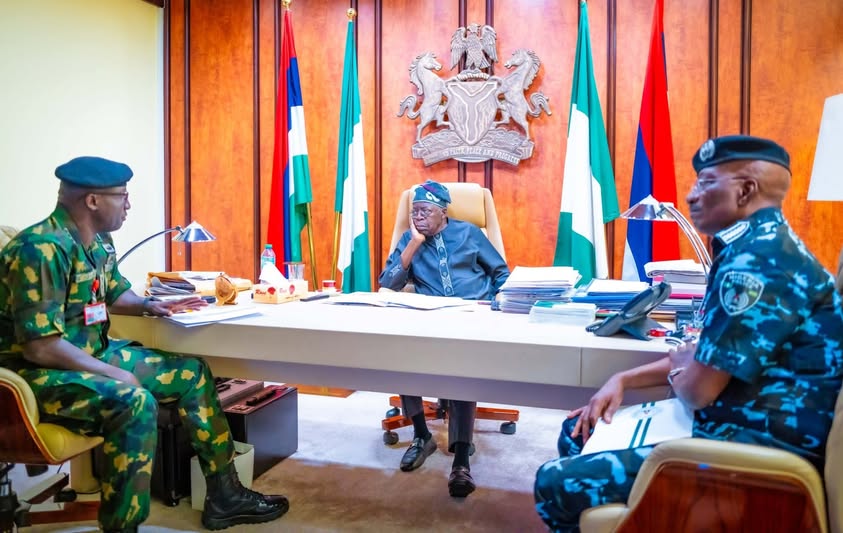
Yesterday again, photos appeared of the Service chiefs briefing the President ALONE, with no Ministers of Defence in sight.
This practice is wrong.
This practice confuses the chain of command.
This practice undermines institutional discipline.
This practice makes the position of the Ministers of Defence, the CDS (Chief of Defence Staff) appear unnecessary and ornamental.
Come to think of it, too frequent direct meetings between President and Commander in Chief somehow demystifies the office (ordinarily the Service chiefs should dread any direct summons by the President). You’d not see any US President or head of any democracy meeting directly with his Service Chiefs.
To be fair, this bad habit did not start today.
It started under the late President Muhammadu Buhari, where monthly (sometimes weekly) Villa meetings with Service Chiefs—whether or not the Ministers were present—became the norm. Unfortunately, the current administration has continued the same practice, despite claiming to embrace better democratic procedures.
A CRITICAL CLARIFICATION WE KEEP IGNORING
This issue of a confused military chain of command has been discussed in many military forums and in several unimplemented reports of committees on the needed reform in the Nigerian military.
In a proper system, the only uniformed military officer who should have direct access to the President — and even that sparingly — is the Chief of Defence Staff (CDS). Why? Because the CDS is the only military officer recognised as a statutory member of the National Security Council, as specified in the Constitution.
The CDS is the interface, the bridge between the military and the civilian authority.
Not the individual Service Chiefs.
Not multiple uniforms trooping to the Villa.
But in Nigeria, as usual: We “copy” systems, then we “paste” wrongly.
WHY THIS MATTERS
Direct, unstructured access of Service Chiefs to the President:
a. Short-circuits the chain of command
b. Weakens the authority of the Ministers of Defence
c. Encourages personalised rather than institutional loyalty
d. Politicises military leadership
e. Creates dangerous ambiguity about who actually commands whom
f..Destroys the principle of objective civilian control
No functional democracy operates this way.
No serious military system allows this.
And no country that values stability would tolerate this confusion.
A CALL FOR SANITY AND PROFESSIONAL PROFESSIONALISM
Nigeria must urgently return to an institutionalised, rules-based structure:
Service Chiefs → Ministers of Defence → President
Intelligence Agencies → National Security Adviser → National Security Council → President
CDS → Only uniformed officer with controlled, constitutional access to the President
The President should not be receiving frequent, ad hoc, unsupervised Villa briefings from the Service Chiefs. This practice should be discontinued immediately.
A nation’s security cannot be managed through improvised meetings, blurred lines, and confusing command relationships.
We cannot claim to be a democracy while running a military–executive relationship that is more personalised than professional.
Nigeria deserves a defence architecture where institutions, not personalities, guide decision-making.
I end with an example of what could happen in a confused Chain of Command; The ENDSARS protest ended with an up till now an unanswered question: Who ordered or requested the troops to deploy? Research would turn up with several possibilities depending on your source. It could have been :
a. The then GOC 81 Division
b. The then COAS
c . The then President
d. Governor of Lagos state
e. The then Chief of Staff to the President
Such confusion in chain of command is dangerous. It can be corrected by discontinuing it procedurally and amending the Armed Forces Act and or the Constitution to specify the chain of command, clearly enumerate clearly and unambiguously the roles and responsibilities of the Minister of defence , the CDS and the Service chiefs.
ADDENDUM: Among the first comments on this post is a reminder by Ibrahim Mohammed that in US the President, every President appoints a seasoned security person as Secretary of Defense. True. My post is for all times going forward not minding the lack of quality of the present Ministers of Defence.
By Group Captain Sadeeq Garba Shehu (rtd)