
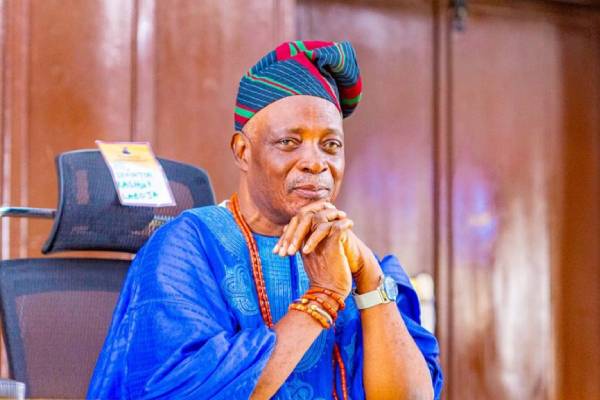
The Olubadan of Ibadanland, Oba Rashidi Adewolu Ladoja, has warned that Nigeria’s insecurity challenge is lingering for far too long, leaving citizens uncertain about their safety and slowing national development.

The monarch identified insecurity as one of the major areas where Nigeria’s Fourth Republic is under-performing, alongside corruption, weak institutions, socio-economic pressures, flawed elections, poor adherence to the rule of law and weak political parties.
Oba Ladoja, a former Governor of Oyo State, said persistent security threats, including insurgency, banditry, kidnapping and ethnoreligious violence, continue to endanger lives and property, while undermining economic and social progress.
Referring to remarks by Nigeria’s Foreign Minister at the World Economic Forum in Davos, the Olubadan said while insecurity may not be nationwide, its prolonged nature has made citizens increasingly anxious.
“As long as we have not yet had an insurrection, it is still scattered. But it is lasting too long,” he said. “Nobody feels safe because you don’t know where the next attack will come from or who will be attacked next.”
The monarch rejected claims that insecurity in Nigeria is fundamentally a religious problem, arguing that such narratives are often exploited by perpetrators for personal or political gain.
“I don’t agree that it is a religious issue. It is not,” he said. “Some people make it look so for their own benefit. Call it banditry, call it kidnapping, anything associated with insecurity is something Nigeria cannot afford to allow to keep growing.”
On corruption, Ladoja said systemic and institutional weaknesses remain major obstacles to effective anti-graft efforts, stressing that political interference has eroded public confidence in enforcement agencies.
“We like to fight corruption, but sometimes those charged with fighting it want to take their own share,” he said, questioning the impression that politicians suddenly become innocent after changing political parties.
“If you change from one party to another, does that make you a saint from a devil?” he asked, urging agencies such as the EFCC, ICPC, police and DSS to uphold their oath of office and act independently.
The Olubadan also highlighted Nigeria’s socioeconomic challenges, citing widespread poverty, youth unemployment and inequality as consequences of governance failure.
He questioned whether the growth in Nigeria’s economy would eventually translate into better living conditions, including access to quality healthcare, food security and potable water.
Ladoja called on governments at all levels to work towards a system where Nigerians would no longer need to seek medical treatment abroad, insisting that no citizen should be denied basic services.
Ladoja criticised the increasing role of courts in determining election outcomes, calling for reforms to ensure that votes, rather than litigation, decide winners.
“A situation where 80 to 90 per cent of election results are challenged in court is not the norm in other democracies,” he said. “We must ensure that votes count and that it is the choice of the people, not the courts, that leads to power.”
He warned that the trend has placed severe strain on the judiciary and, in some cases, eroded public confidence in court judgments.
On the electoral process, the monarch said elections are frequently marred by violence, political thuggery, weak internal party democracy and the imposition of candidates.
He also criticised weak adherence to the rule of law, noting that failure by leaders to respect constitutional provisions and court rulings has widened the gap between democratic ideals and practice, while undermining public trust in the judiciary.
Speaking on political party weakness, Ladoja said many parties lack clear ideology or programmes, focusing mainly on access to power.
He added that party indiscipline and a winner-takes-all mentality continue to weaken democratic consolidation and citizen confidence in the political system.
The monarch also questioned why successive governments have failed to guarantee access to education for all Nigerian children despite 26 years of uninterrupted democratic rule.
“Many of our children are out of school. Should that be happening in Nigeria today?” he asked, warning that denying education to large numbers of children poses serious dangers to the country’s future.
Despite the challenges, the Olubadan acknowledged that Nigeria’s Fourth Republic has recorded notable gains, particularly uninterrupted civilian rule for over 25 years.
“The most significant achievement of the Fourth Republic is over 25 years of continuous civilian government, a milestone none of the previous republics attained,” he said, noting that this has fostered relative political stability.
He also cited peaceful transitions of power, expanded political freedoms, increased citizen participation, gradual strengthening of democratic institutions and economic liberalisation as areas of progress.
Recalling the 2015 elections, he described the defeat of an incumbent president by an opposition party and the peaceful handover of power as historic milestones that strengthened democratic norms.
Ladoja called for sustained constitutional and legal reforms, stressing that laws must continue to evolve to meet the needs of the people.
He said law-making should not be limited to the National Assembly, noting that state assemblies and local governments also have constitutional powers to enact laws that improve citizens’ welfare.
Expressing concern over inconsistent interpretation of laws, he said legal uncertainty weakens accountability and the rule of law.
The Olubadan commended the Media Trust Group for sustaining the Daily Trust Dialogue for 23 years, describing it as a vital platform for national reflection.
“Over the years, this dialogue has stimulated critical discussions on Nigeria’s socio-political and economic development and that of the African continent,” he said, noting the diversity of participants the forum continues to attract.