
By Group Captain Sadeeq Shehu Garba (rtd)

A military colleague asked me a simple but important question: should we not be happy that the United States is helping us? My answer was straightforward. Yes, we should be grateful—grateful that America, or any other partner, is willing to assist Nigeria in confronting a security challenge we have struggled to conclusively resolve for over fifteen years. But gratitude must be matched with caution, guided by the hard lessons of history. And it must also be accompanied by a quiet sadness—sadness that a country of Nigeria’s size, talent, and potential has reached a point where external help is needed to complete a task that should, in time, have been firmly within our own capacity. Happy, grateful, but cautious and sad.
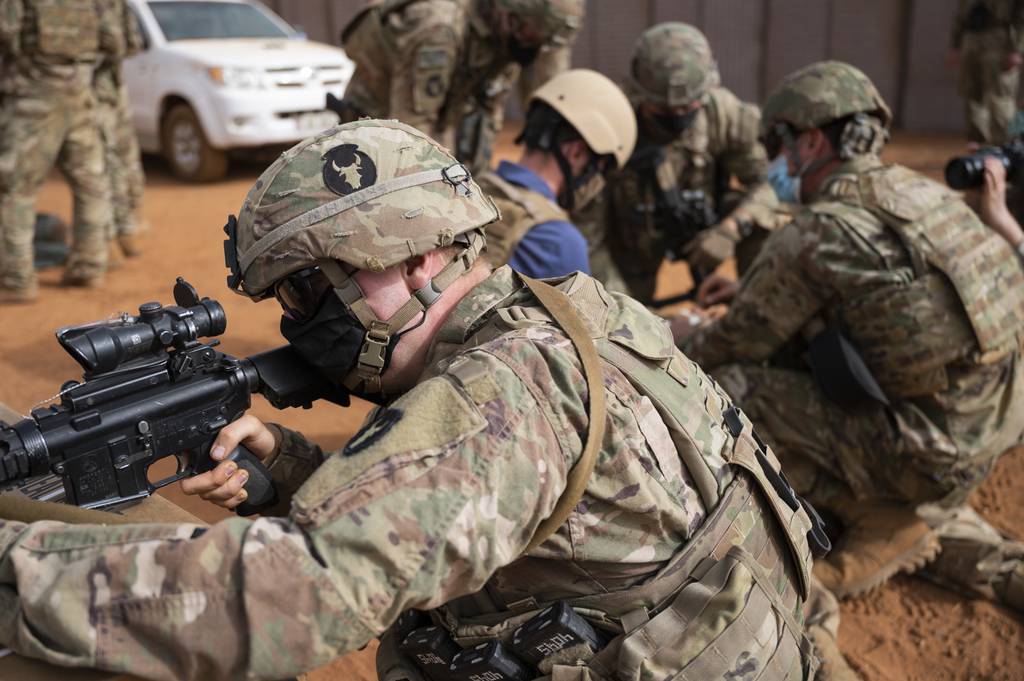
Nigeria’s security challenges are real, complex, and evolving. Terrorism, banditry, and transnational extremist networks do not respect borders. In this context, cooperation with capable international partners—including the United States—is legitimate, lawful, and often necessary. Many responsible states have done the same.
This explainer is therefore not an argument against cooperation. It is a reflection on how Nigeria should cooperate wisely, confidently, and on its own terms, drawing on history, best practice, and recent experience.
1. JOINT OPERATIONS ARE LEGITIMATE — BUT NIGERIA MUST REMAIN IN COMMAND
International law permits a sovereign state to invite assistance from another state to conduct military operations within its territory. Nigeria exercised that right.
However, consent does not mean abdication.
When operations take place on Nigerian soil:
• Nigeria must retain control over target selection and timing
• Nigeria must retain political ownership of outcomes
• Nigeria must retain full responsibility to its citizens
No matter how advanced a partner’s technology may be, the effects land on Nigerian communities, and accountability ultimately rests with Nigerian authorities.
2. NIGERIANS MUST HEAR FIRST FROM THEIR OWN GOVERNMENT
A critical principle in any joint operation is who speaks first to the people.
When military action occurs inside Nigeria—whether conducted solely by Nigerian forces or jointly with partners—the primary voice to Nigerians must be the Nigerian Government, led by the President of the Federal Republic.
Even where a foreign partner provides platforms, intelligence, or munitions, once approved, the operation is a Nigerian sovereign act. As such:
• Nigerians should hear confirmation first from Abuja, not from a foreign capital.
• Official framing, reassurance, and explanation should come from the Nigerian President or Government, not external leaders.
• External partners may address their domestic audiences, President Trump may speak in a language that appeals to his political base back in the US, but they should not be the first narrators of events on Nigerian soil.
Allowing a foreign leader to announce or frame strikes in Nigeria before Nigerian authorities:
• weakens public confidence in national ownership,
• fuels confusion and speculation,
• imports external political or religious narratives that may not reflect Nigeria’s realities,
• and places Nigerian officials in a reactive posture.
Best practice is simple and well established: When operations occur at home, the home government speaks first.
3. PRECISION TECHNOLOGY REDUCES RISK — IT DOES NOT ELIMINATE IT
Modern military systems are accurate and intelligence-driven. But no system is infallible. Even the most advanced armed forces openly acknowledge:
• misidentification,
• intelligence gaps,
• navigation or targeting errors,
• weapon malfunction,
• human judgment failures.
This is not a criticism of any partner; it is a military reality.
Nigeria must therefore approach joint operations with the understanding that precision does not mean zero error, and that robust safeguards and review mechanisms are essential.
4. NARRATIVES MATTER AS MUCH AS PRECISION GUIDED MUNITIONS
Military operations do not occur in a vacuum. How they are explained matters almost as much as how they are executed.
External partners will naturally speak to their own domestic audiences. Nigeria, however, must communicate first and foremost with its own people, in language that:
• avoids religious or civilisational framing,
• reflects local knowledge,
• reassures affected communities,
• preserves national cohesion.
In a diverse society like Nigeria, discipline in messaging is a security issue, not a public-relations detail.
5. WHAT HISTORY SHOWS: HOW INTERVENTIONS OFTEN START — AND HOW THEY END
History shows a recurring pattern in U.S. military engagements abroad. They often start small, but do not always end small.
In Afghanistan, operations began in 2001 as precision strikes and special operations against Al-Qaeda, but evolved into a 20-year campaign involving advisers, bases, and state-building, ending in withdrawal with mixed outcomes. The lesson is that entry objectives must be matched with credible exit conditions.
In Libya, a limited no-fly zone to protect civilians in 2011 evolved into regime collapse without a stabilisation framework, resulting in prolonged instability. The lesson is that what follows a strike matters as much as the strike itself.
In Somalia, counter-terrorism strikes and training support became a long-term, low-visibility campaign that continues today. The lesson is that “limited” missions can quietly become enduring.
In Iraq, action restarted in 2014 as a focused campaign against ISIS, but expanded into sustained air operations and advisory roles, with a residual presence remaining. The lesson is that mission creep is incremental and rarely announced upfront.
These examples are not indictments. They are patterns that serious security planners study carefully.
6. IS THERE A POSITIVE EXAMPLE OF SUPERVISION THAT NIGERIAN CAN FOLLOW ? YES — COLOMBIA
Colombia offers a useful example through Plan Colombia.
There, the United States provided intelligence, funding, training, and technical support, but Colombian forces remained in command of operations. National priorities were set in Bogotá, not Washington. U.S. involvement was bounded by law and process, and the emphasis shifted steadily toward capacity-building rather than substitution.
The lesson is clear:
Foreign assistance works best when it is structured, bounded, and subordinate to national strategy.
7. PRACTICAL GUIDELINES FOR NIGERIA GOING FORWARD
Drawing on Nigeria’s experience and global lessons, Nigeria should consistently insist on:
• clear legal authorization under Nigerian law,
• Nigerian control over targets and timing,
• defined geographic and operational limits,
• mandatory after-action reviews shared with Nigerian authorities,
• transparent civilian-harm assessments when incidents occur,
• clear disengagement or pause mechanisms agreed in advance.
These are not barriers to cooperation. They are best practices of confident states.
8. PARTNERSHIP SHOULD BUILD CAPACITY, NOT DEPENDENCY
Nigeria’s long-term objective should be to learn, strengthen its own forces, and reduce reliance over time.
External support should accelerate Nigerian capability, not replace Nigerian responsibility.
MY FINAL REFLECTION
Nigeria does not weaken itself by working with partners.
Nigeria weakens itself only when it fails to define the terms of that partnership. The balanced path forward is therefore clear:
a. Cooperate, but with rules (written and signed , not just handshake)
b. Accept assistance, but retain command.
c. Speak first to your own people when there is any incident .
d. Use the partner’s technology, but protect sovereignty.
e. Learn from history, not repeat it.
That is how serious nations secure themselves—with partners, but firmly in charge of their own destiny.
First posted on December 28, 2025
@Group Captain Sadeeq Garba Shehu (rtd) is a Security & Defence Analyst/Conflict Security & Development Consult Ltd