
By Chidi Omeje

There was a moment when Nigeria stood at the edge of what could have been one of the most humiliating episodes in its modern diplomatic history.
Accusations of “Christian genocide” echoed from Washington under President Donald Trump. The rhetoric was harsh. The threats were louder. At one point, the possibility of unilateral military action against Nigeria was openly discussed in American political circles, framed as a campaign against so-called “Islamic jihadists.” Then came the Christmas Day bombing in Sokoto in 2026, a dramatic escalation that could have spiraled into prolonged foreign intervention.
Many expected outrage. Others predicted diplomatic collapse. Some even feared the beginning of an externally dictated security architecture imposed on Nigeria.
But that is not what happened. Instead, Nigeria chose something far more powerful than chest-thumping: composure.
At the height of the tension, Abuja resisted the temptation of megaphone diplomacy. There were no reckless retaliatory statements. No emotional ultimatums. No performative nationalism.
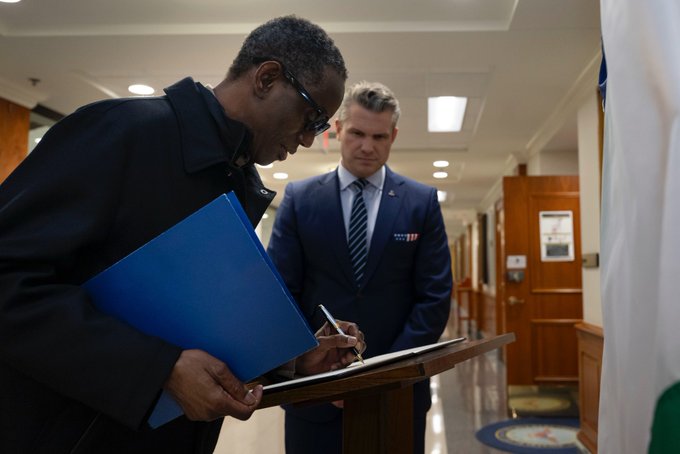
Rather than escalate rhetoric, Nigeria escalated engagement. The National Security Adviser, Nuhu Ribadu, led a high-profile delegation to Washington. Behind closed doors, the real work began; not of confrontation, but of clarification. Not of submission, but of negotiation. Not of humiliation, but of recalibration.
Nigeria did not deny its security challenges. It did not dismiss American concerns outright. But it firmly rejected any narrative that portrayed the country as incapable of managing its own sovereignty.
What emerged from that sustained interface was cooperation instead of occupation. That distinction matters.
Fast forward to Monday, February 16, 2026, when the Director of Defence Information at the Defence Headquarters, Maj Gen Samaila Uba, announced the arrival of about 100 United States military personnel at Bauchi Airfield.
According to the statement he issued, the presence of American team is the direct product of a formal request by Nigeria.
That, to me, is a fundamental shift in tone and power dynamics.
These American personnel are not combat forces. They are advisers. Trainers. Technical specialists.
They will operate strictly under Nigerian authority, direction, and control. This is structured military cooperation anchored in Nigeria’s sovereignty.
It is the difference between being acted upon and acting by choice.
What could have become a humiliating foreign intervention has instead matured into a bilateral defence partnership grounded in mutual respect.
Nigeria’s handling of the crisis demonstrates a lesson often ignored in global politics: strength is not always loud. It would have been easy to respond with nationalist fury when Washington’s rhetoric peaked.
It would have been politically popular to frame the situation as neo-imperial overreach. But that path could have isolated Nigeria diplomatically and deepened mistrust between two strategically important nations.
Instead, Abuja played the long game. By maintaining calm and pursuing quiet diplomacy, Nigeria reframed the narrative. The discussion shifted from “U.S. invasion” to “U.S–Nigeria defence cooperation.”
That reframing did not happen by accident. It happened through disciplined engagement.
The current arrangement which is focused on specialized training, intelligence sharing, and technical support, will strengthen Nigeria’s counter-terrorism capacity without compromising its sovereignty. It enhances deterrence while preserving dignity.That is strategic statecraft.
Critics may still question foreign military involvement. That scrutiny is healthy in any democracy. But the facts matter.
The US personnel are non-combat advisers. Training activities remain under Nigerian command. The collaboration was initiated through a formal request by the Federal Government of Nigeria. Transparency has been promised by Defence Headquarters.
The objective is capacity enhancement and not foreign substitution.
In an era where global security threats are transnational, strategic cooperation is not weakness. It is realism.
What we are witnessing is more than the arrival of trainers at Bauchi. A potential flashpoint that could have scarred Nigeria’s sovereignty has instead evolved into structured collaboration. A moment that could have defined Nigeria as a target of intervention has been reshaped into one of engagement and agency.
The episode reveals an important truth: sovereignty is not preserved merely by resisting power, but by skillfully negotiating with it. Nigeria did not bow. Nigeria did not bluster. Nigeria negotiated.
And in doing so, it transformed a tense standoff into a working partnership with the world’s most powerful nation. That is strategic maturity.
*Chidi Omeje is the publisher of Security Digest (www.securitydigestng.com)