
By Abubakar Adam Ibrahim

The world has gone loco again. As the Middle East burns, torched by a completely needless war pursued with impunity and little regard for regional stability or even respect for international law, attention has predictably shifted to that conflict. Even Nigerians are glossing over the war at home to render analysis and commentary on the war in the Middle East. The Islamic Movement of Nigeria, known to have Iran as its spiritual compass, staged a massive protest in Nigeria that made international headlines.
While this is ongoing, the wanton killings of Nigerians have continued unabated by terrorists and bandits and will most likely receive far less attention, even from Nigerians who are already too jaded by the endless cycle of violence. It is easy to get tired and to lose hope.
Because each time a group of abducted school students gets off those “rescue” buses, instead of relief and applause that the ordeal is over, Nigerians are often left with more questions. The Nigerian government always claims to have “rescued” them. The victims are ostentatiously dressed in fresh uniforms produced overnight, transported on buses, or sometimes even flown to the capital for photo ops with the governor, and some lucky ones get flown to Abuja to meet the president.
However, the relief about their rescue is almost always instantly tainted by questions. How were they rescued? Who were they rescued from? What happened to their abductors? Were they arrested to face legal consequences for their crimes, or were they perhaps killed during the “rescue” efforts? Sadly, the government never addresses this and instead spends considerable time presenting their return as a triumph, thereby failing to investigate how we lost them in the first place and how we can prevent it from happening again.
Whispers of millions being paid in ransom for the release of the victims have always been swirling in the ether. Every rational Nigerian knows that in these operations, it is money, not bullets, that secures freedom for the victims. The recent AFP investigation that claimed that just this November, the federal government dumped about $7 million into the coffers of Boko Haram to free the nearly 300 students abducted from St. Mary boarding school in Papiri, Niger State, comes as no surprise. Despite the strenuous denial by the government, the reality, as people say, is that if it walks like a duck and quacks like one, it’s probably a waddling agwagwa. Since the report was published, I have been pondering what happens to a country’s fight against terrorism when the state itself is accused of bankrolling the insurgents.
Despite the politicisation of terror financing, with successive governments since 2011 threatening to release the names of said financiers and yet somehow never managing to do so, it is a known fact that ransom payments constitute a large source of funding for terror. These payments are often from family members desperate to secure the release of their loved ones, because in most cases, the authorities simply do not have the capacity to rescue them, or payments from the government itself to the terrorists. This may not be out of a desire to create havoc, nor really because it cares about the victims, but because it cares more about the damaging optics of losing 300 students to terror, especially at a time when Trump is dragging Nigeria through the mud for its shoddy handling of insecurity in the country.
Nigeria’s shadow kidnap-for-profit economy has an annual turnover in the billions. The Lagos-based SBM Intelligence reported that between July 2024 and June 2025, different gangs abducted 4,722 persons in 997 incidents. The gangs demanded about N48 billion and received N2.57 billion in verified payments. That is just within a one-year window, quadrupling the payments made in 2022. Because of our poor documentation habits, the actual figures could be triple what is reported.
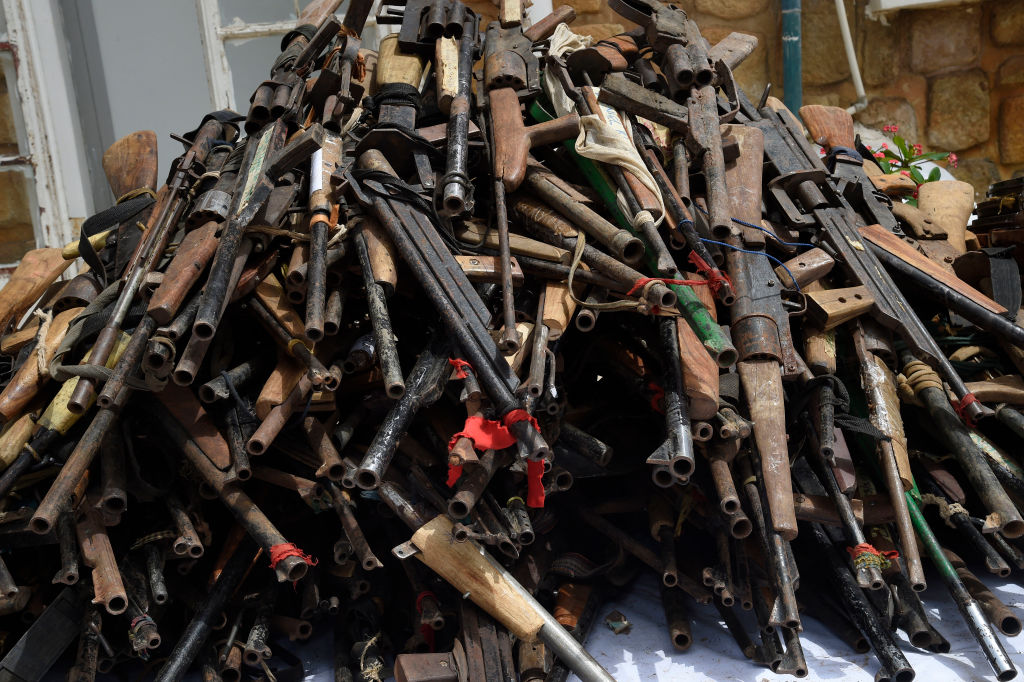
A 2024 National Bureau of Statistics (NBS) household survey that captures unreported cases found that between May 2023 and April 2024, Nigerians paid about N2.23 trillion in ransom to kidnappers. This exceeded the country’s 2024 defence budget, which was about N1.65 trillion. In the end, these huge figures go into the procurement of better weapons by the bandits and terrorists and result in the proliferation of the terror they unleash on Nigerians and their resistance to the military. One single large-scale payment could buy weapons and vehicles for the terrorists, pay insurgents, and fund new recruitment drives.
Successful operations by the terrorists to raise significant funding through ransom payments for mass abduction embolden the criminals by showing them that schoolchildren are profitable assets, not offlimits. This also applies to high-profile mass abductions that titillate the politics of the day.
The government cannot deny that it has contributed a significant chunk to this terror purse. Despite the Terrorism (Prevention and Prohibition) Act, 2022, which stipulates 15 years in prison for anyone who makes any ransom payment, state-sanctioned payments keep recurring. Realistically, the law exists on paper. Families and communities, and sometimes even state actors, are left with no choice but to negotiate quietly with the bandits and make the payments to save lives. What are the alternatives? Rescue operations that are incredibly rare? How can a government credibly threaten citizens with prosecution for paying ransoms while allegedly doing the same, at a far greater scale, in secret?
The AFP report claims that just this November, this government paid a billion in just one kidnapping incident, and the money was ferried by helicopter to a Boko Haram enclave and handed over to a known Boko
Haram commander. In addition, the reports claim two terror leaders were released as part of that deal.
Of course, the Minister of Information, Mohammed Idris, and the office of the National Security Adviser (ONSA) have denied the claims, and the Department of State Services (DSS) has called the claims “laughable.”
The truth, though, is that there is nothing laughable about the claims or the situation we are in. Thousands of Nigerians have been killed by terrorists and bandits, sizeable chunks of the country are governed by terrorists and bandits, and millions of Nigerians have been displaced from their homes while thousands of villages and hamlets have been abandoned by the residents.
Over the last two decades, the National Financial Intelligence Unit (NFIU) has documented a pattern of transactions that have included “protection fees,” cash-intensive trade (livestock, small commodities), smurfing of deposits and withdrawals, cross-border cash movement, and the use of informal value transfer systems that have continued to fill the bandits’ coffers. They have control over vast territories that they tax for revenue, impose “protection levies,” and operate mining sites. These are major revenue streams for Boko Haram, ISWAP, and allied bandit networks.
I don’t expect the government to accept or admit that it has paid ransoms to bandits and terrorists. There is a political logic to the denial. Admitting that payments like that have been made invites legal challenges, public outrage, and international scrutiny, which the country cannot afford. Furthermore, the secrecy surrounding these deals creates fertile ground for corruption, side deals, and kickbacks since those accounts cannot be audited. We had Chibok, Dapchi, Kankara, and Kaduna train, where questions about ransom payments and prisoner swaps are still floating unanswered. The larger implication is that these secret deals weaken public trust in the state, especially when leaders insist that “no ransom was paid” while not providing credible alternative explanations. Nowhere in history has counter-terrorism been credible if citizens suspect their own government of underwriting violence.
There is no easy way to address this dilemma. We must incorporate kinetic and non-kinetic measures to tackle this problem. First, Nigeria must train, arm, and equip rapid response units at strategic locations across the country that cover every zone. These units must be elite and mobile and be able to respond to distress calls in their zones within minutes. Since we do not have the ground troops to militarise the country, this could be a viable alternative.
The non-kinetic efforts must include transparent, legislated frameworks that provide stronger oversight of any negotiations, including after-action reporting to the National Assembly in closed sessions. This must also account for investment in prevention by securing schools and strategies for dismantling the wider kidnap-for-profit economy. Instead of waiting for the next major crisis, in addition to the now habitual daily abductions, we must adopt proactive measures to pre-empt this crisis and aim to end them. Nigeria cannot afford a war on terror that quietly writes cheques to the enemy while asking its citizens to pay in fear and silence.
Abubakar Adam Ibrahim, a columnist with Daily Trust, can be reached through abubakaradam@dailytrust.com
Twitter: @Abbakar_himself
WhatsApp: 08020621270