
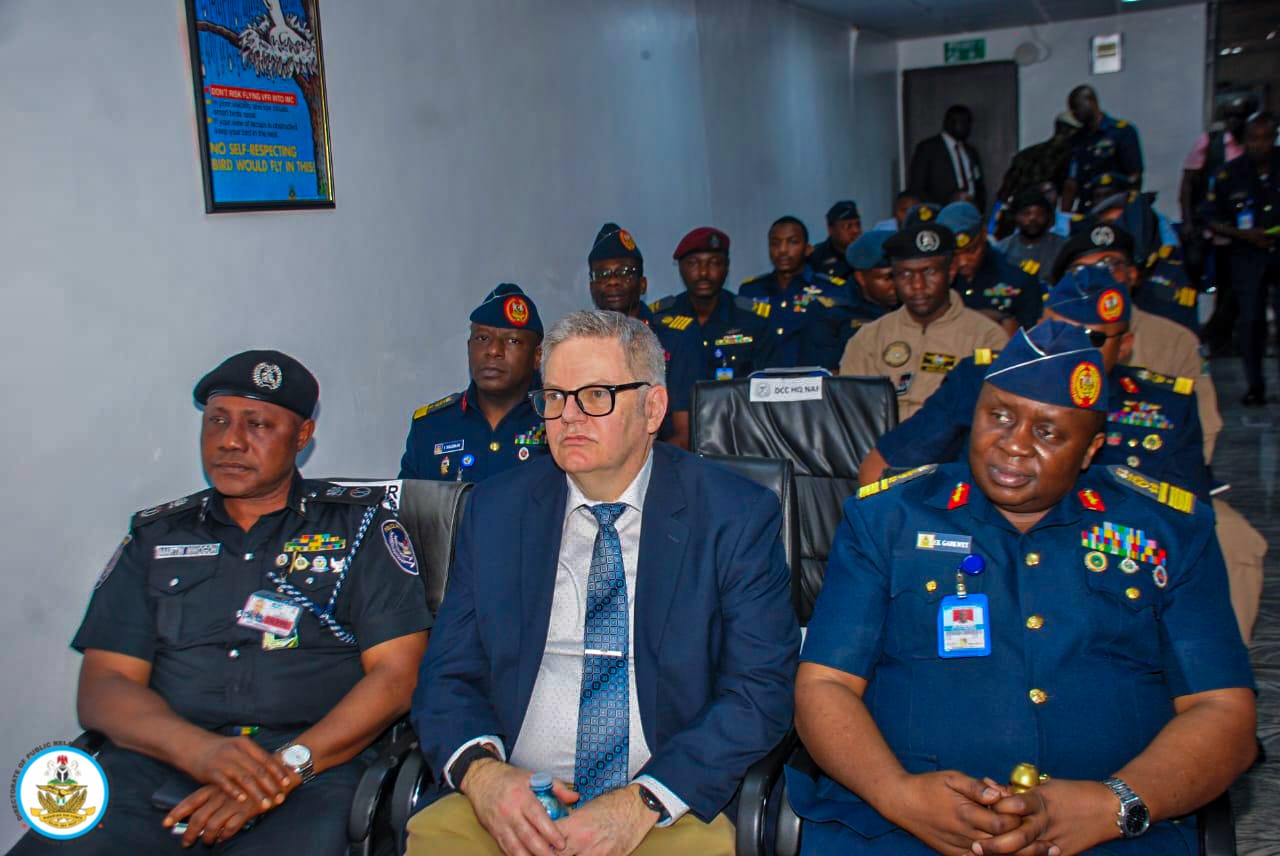
Chief of the Air Staff (CAS), Air Marshal Sunday Kelvin Aneke, has inaugurated the Basic Civilian Harm Mitigation (CHM) Course 1/2026 at the Air Warfare and Doctrine Centre (AWDC), Abuja, reaffirming the Nigerian Air Force (NAF) “unwavering commitment” to the protection of civilians while sustaining intense operational pressure on terrorist elements across various theatres of operation.

The course has 26 participants comprising air component commanders, operational pilots, Unmanned Aerial Vehicle operators, legal advisers, and Civil-Military Relations officers, and is aimed at strengthening professional judgement and operational decision-making in environments where civilians and combatants are often intermingled.
Air Marshal Aneke noted that ongoing joint military operations have significantly degraded the operational freedom of terrorist groups, forcing them to increasingly resort to desperate tactics.
He emphasised that “the NAF, in close coordination with other security agencies, maintains persistent surveillance, rapid response capability, and strong interagency collaboration to ensure that hostile elements remain under sustained pressure.”
Represented by Director of Air Operations, Headquarters NAF, Air Vice Marshal A Bamidele, the CAS stressed that safeguarding civilian lives during air operations is not a constraint on military effectiveness but rather a force multiplier that enhances operational legitimacy and success.
According to him, Civilian Harm Mitigation remains a critical component of modern air operations as it reinforces the NAF’s commitment to protecting civilian lives and infrastructure while delivering decisive air power.
“Safeguarding civilian lives is not a limitation to military effectiveness; rather, it is a force multiplier that strengthens operational legitimacy, builds public trust, and reinforces the Nigerian Air Force’s reputation as a professional and responsible force,” Air Marshal Aneke stated.
The CAS explained that the Basic CHM Course was carefully designed to equip participants with the knowledge, skills, and judgement required to effectively integrate civilian protection considerations into operational planning, intelligence processes, targeting decisions, and mission execution.
He noted that the training will deepen participants’ understanding of International Humanitarian Law, Rules of Engagement, positive target identification, and other critical measures aimed at preventing or minimising civilian harm during operations.
Air Marshal Aneke therefore urged participants to approach the course with utmost seriousness, stressing that the knowledge gained must translate directly into operational decision-making. “The knowledge you acquire here must not remain theoretical; it must guide your decisions in planning rooms, command centres, and operational theatres,” he added.
In his remarks, the Chief of Civil-Military Relations, Headquarters NAF, Air Vice Marshal Edward Gapkwet, observed that in today’s complex operating environment, military success is not defined solely by tactical or kinetic outcomes but also by how operations are perceived, how civilian harm is prevented or addressed, and how lessons learned are institutionalised within the Service.
Earlier in his welcome address, Commandant of AWDC, Air Vice Marshal GI Jibia, highlighted the Centre’s expanded mandate to conduct Air-Ground Integration and Civilian Harm Mitigation training for the Armed Forces of Nigeria to enhance joint operational effectiveness in line with international best practice.