


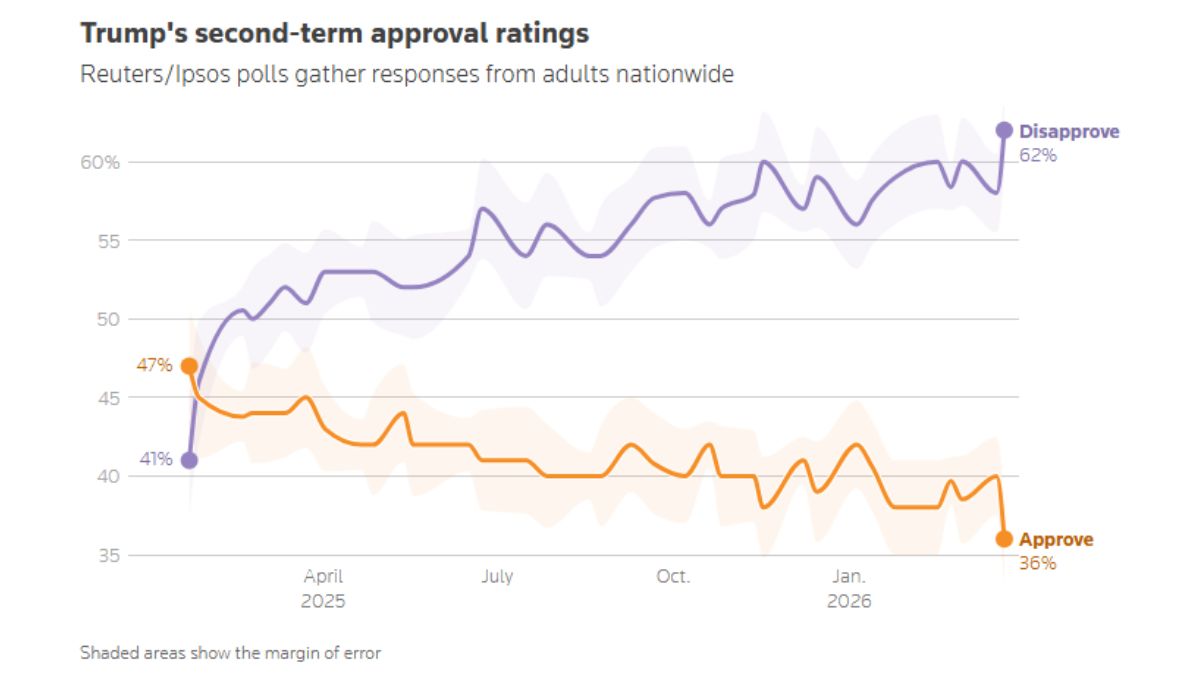
President Donald Trump’s approval rating has plunged to an all‑time low of 36 per cent as the American war on Iran worsens an already dire cost‑of‑living crisis.

A Reuters-Ipsos survey conducted this month found that just 36 per cent Americans approved of Trump — down from 40 per cent the previous week.
Trump’s approval has plunged sharply as an overwhelming majority of Americans reject his handling of the economy and disapprove of his war on Iran.
The war on Iran raised oil and gas prices in the United States to the highest point in decades at a time when economic growth had already plunged, unemployment had risen to the highest point in over two decades, and tariffs made nearly 100,000 factory workers jobless in his second term.
Just 35 per cent of Americans approved of the war on Iran, down from 37 per cent the previous week, and just 29 per cent approved of Trump’s handling of the economy — lower than any approval rating of his predecessor Joe Biden.
Since Trump launched an unprovoked war on Iran last month, average petrol prices have risen around 34.5 per cent in the United States.
The war-induced petrol price rise is the largest in 30 years. For context, not even Hurricane Katrina in 2005 (30 per cent), the Russian full-scale invasion of Ukraine in 2022 (24 per cent), the 2008-09 global financial crisis (21 per cent), or the 1999 Opec cuts (21 per cent) match the surge.
?im=FitAndFill=(596,336))
Even Republicans appear to be feeling the economic pinch as only 27 per cent of them approve Trump on the cost-of-living crisis compared 34 per cent the previous month.
Overall, however, Republicans continue to rally around Trump as only around 20 per cent disapprove of his overall performance.
The cost-of-living crisis could worsen in the coming days as the Strait of Hormuz continues to remain blocked and oil prices hover at around $100 a barrel. Even as the United States is relatively insulated from the energy shock as the world’s largest oil and gas producer, it is bound to feel a bigger pinch soon as lots of foodstuff, consumer goods, and raw and intermediate industrial goods are imported into the country that are set to cost more because of rising freight fares.
Maersk CEO Vincent Clerc has previously told BBC News that shipping costs have surged by up to 15-20 per cent since the war began and these costs are being passed down to consumers.
@Firstpost