

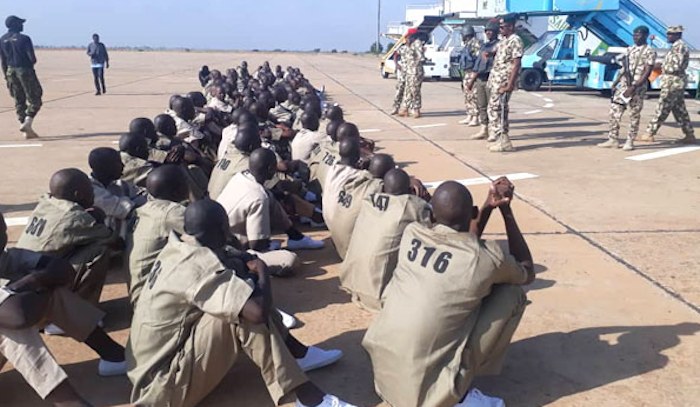
The Defence Headquarters, DHQ, has dismissed as misleading and distorted, claims circulating on social media concerning remarks by the Chief of Defence Staff (CDS), General Olufemi Oluyede, on the military’s deradicalisation initiative, Operation SAFE CORRIDOR (OPSC), saying that contrary to the reports, the Nigerians military is not prioritising leniency for active and repentant terrorists over justice for victims.

In a statement, Director of Defence Information (DDI), Major General Samaila Uba, said General Oluyede’s remarks was deliberately distorted and misrepresented, accusing the media of framing strategy that selectively amplified certain phrases while ignoring the full context.
The Operation Safe Corridor was set up in 2015 for the Deradicalisation, Rehabilitation and Integration (DRR) of surrendered and repentant terrorists.
General Oluyede, who spoke on Tuesday at the Armed Forces inaugural lecture for the newly established Joint Doctrine and Warfare Centre (JDWC) at the Nigerian Army Conference Centre and Suites, Abuja said: “Talking about Operation Safe Corridor, so many people have asked that question: why do we need to rehabilitate criminals? They all should be killed because they have killed people. Well, that may make sense…
“But even in the Bible, we heard about the prodigal son. If there was not that window for the man to come back, would they have come back? So the point is that these are Nigerians, mostly. And it’s important for us to give them that window to repent, if they want, rather than pushing them to the extreme. To say, okay, ‘It’s either we kill you, or you continue with the adventure.’
“I think it is important for us to make people understand, especially the National Assembly, because as we speak now, everything about the safe corridor is being given by the Defence Headquarters.”
But General Uba, in the statement, said the portrayal of General Oluyede’s statement by the media “is not only inaccurate but also undermines ongoing national security efforts. First, it is important to clarify that Operation Safe Corridor is not an amnesty programme but a carefully structured deradicalisation, rehabilitation and reintegration initiative targeted strictly at surrendered, screened and low-risk former combatants. The programme forms part of a broader counter-insurgency strategy combining kinetic and non-kinetic approaches.
“Evidence shows that hundreds of individuals have passed through this process since inception, contributing to intelligence gathering and weakening insurgent structures.
“Second, the comments by the CDS were made within the context of a professional military doctrine lecture, emphasising the importance of multi-dimensional conflict resolution. His remarks highlighted global best practices where rehabilitation complements battlefield successes, not replaces them. Any attempt to frame these remarks as sympathy for terrorists is a gross misinterpretation.
“Third, the Nigerian Armed Forces remain unequivocally committed to neutralizing active terrorists and protecting law-abiding citizens.”
Uba said the leadership of the Armed Forces being misrepresented continues to direct aggressive operations across various theatres of conflict, adding that Operation Safe Corridor simply addresses a different category of individuals – those who have voluntarily disengaged and met strict profiling criteria.
He said that strategic communication in modern warfare recognises the importance of de-radicalisation as a tool to reduce recruitment pipelines and break cycles of violence.
“The selective framing seen in the viral post ignores this critical dimension and instead promotes a simplistic and misleading narrative.”
He, therefore, urged the public to disregard sensational and out-of-context interpretations of official statements; rely on verified channels for accurate information on military operations and support ongoing military efforts aimed at restoring lasting peace and security across the country.
“The Armed Forces of Nigeria remain a professional institution guided by law, doctrine and an unwavering commitment to national security. The leadership of General Olufemi Oluyede reflects decades of distinguished service, operational experience and strategic competence in addressing complex security challenges.”