
By Abubakar Adam Ibrahim

On Sunday night, some armed men appeared at the heart of Angwan Rukuba in Jos and started shooting. When they left, dozens of people lay dead. Police officially put the number at 27. But we are not entirely sure of the exact numbers, just as we are not sure who these murderers were – terrorists, bandits, or random criminals – since none of them has been arrested and no group has claimed responsibility.
What we are sure of is that innocent Nigerians were needlessly killed. Yet again. And these killings would likely result in more deaths. The aftermath of the attack was gory. That image of the mother cradling the head of her dead son is unforgettable. It should be one of the defining images of Nigeria’s reality.
This incident put the long-troubled city of Jos firmly back at the centre of the discourse on the politics of insecurity in Nigeria. Whoever knows Jos and understands its complex and crisis-fractured geography will understand that the choice of Angwan Rukuba for the attack could only be one of two things—a complete coincidence or very strategically chosen.
Angwan Rukuba has been pivotal in the crisis that has redefined Plateau State since 2001. It is a sprawling community that, pre2001, was predominantly Christian with a smattering of Muslims. Post the weekend of September 7, 2001, it transformed into a complete Christian district. The Muslims were killed in cold blood or brutally expelled and were lucky to escape with their lives – like my aunt and her children who lived there at the time.
It became a militant Christian area where each time another crisis broke out, hordes of armed youths would march out to attack other communities where Muslims resided. Simultaneously, the majority Muslim population of Angwan Rogo did the same thing their Christian adversaries did in Angwan Rukuba and effectively became a Muslim garrison district.
Sunday night’s attack on Angwan Rukuba was not designed to expel the Christians from that area because realistically that is impossible. It was designed to provoke a reaction and reignite the conflict within Jos. Once Jos is triggered, not only Plateau State but Nigeria as a whole will be triggered.
That is why the tensions following the attack must be managed carefully. It took a curfew to restrain both communities from having a go at each other. Relaxing the curfew on Wednesday led to some violent incidents around the city.
Beyond managing the tensions, sincere efforts must be made to find the perpetrators and bring them to justice. I know I sound like a broken record because I make this same call to action every time. But dispensing justice to perpetrators of crimes like this is the only way to end the crisis and build sustainable peace. The absence of justice is provocation enough. This cycle of violence persists because Nigeria has failed to both protect its people and dispense justice when required.
Instead, we are content with politicising crimes and violent incidents like this. Even before the corpses have been cleared from the scene, that controversial American Alex Barbir afflicted by White Saviour Complex, showed up, set up his camera, with his professional lighting complemented by a bonfire burning behind him to frame the narrative of the attack. It was categorical evidence of Christian genocide, he said, even if some of the victims were Muslims, and called out the Nigerian president, who he said “will pay” for what he was doing.
First, Mr Barbir, a foreigner, has a say in our affairs because apparently foreign terrorists slink through our borders to murder innocent Nigerians all over the country. I don’t blame Mr Barbir and the other foreign agents acting in the country; I blame Nigeria for allowing all sorts of foreign incursions into our civil spaces. The porosity of our borders and the inherent weakness of our government allowed it. Mr Barbir first snuck in as a “humanitarian” helping rebuild houses destroyed in conflict. If the government had secured communities, rebuilt houses, and resettled residents, would Mr Barbir have found an excuse to sneak in?
His knack for showing up in selective conflict areas and his very divisive rhetoric, in which he misquotes the Qur’an out of context to deepen religious divides in the country, is concerning. No reasonable country would allow even its citizens, not to mention a foreigner, to act with such impunity.
Would arresting him end the conflict? To the best of my knowledge, he hasn’t committed any crime that would warrant an arrest. But his activities are concerning enough to warrant an investigation and deportation. This would indicate that the government will not allow all sorts of foreigners to capitalise on local tensions to stoke the flame of insecurity. If the DSS is serious about their duties, they should look into his matter and take the necessary actions. As they should look into the matter of who actually did the killings at Angwan Rukuba and take necessary actions about that.
There has been a massive amount of irresponsibility and incompetence that has led to where we are today. Both political leaders and religious leaders have played their roles in cooking up this stinking stew.
At the beginning of March, Boko Haram raided the village of Ngoshe in Borno and massacred over 150 persons and abducted dozens of others. Obviously, the news coverage about that gruesome incident is not as boisterous as this recent attack, and the outrage that occasioned that massacre is nowhere near the outrage that is accompanying this incident in Jos. It is possible that this is because the perpetrators in that instance were definitely Boko Haram and their victims were mostly Muslims in a small isolated Muslim village.
Yet, not even Muslim religious leaders demonstrated the same level of outrage that Christian religious leaders are exhibiting over Jos. Instead, clerics like Yahya Jingir are dissipating energy on campaigning for the president even before the bona fide politicians have started campaigning. Jingir’s penchant for fabricating outright lies to justify his claims— like claims that this government has cancelled JAMB exams so indigent students can afford university entries, and claims that food prices have dropped dramatically—suggests the man is living in an alternate reality.
When religious leaders whose duties should include calling the attention of political leaders to diligent and just governance are instead obsessed with selling an alternate reality, one in which this government is perfect and Nigerians are not suffering as they are, or being killed as they have been, it is not only disingenuous but is cruel and unconscionable. If he had put half this passion into decrying the insecurity in the country instead of glazing over it, perhaps the political leadership would have been pricked into a more proactive response.
As tensions remain in Plateau, it is important to commend the reports that some members of Christian and Muslim communities are doing their best to grant safe passage to members of the opposite faiths who find themselves in precarious situations. They may not have known it then when they were doing it, but they just managed to defeat the aims of the unconscionable minds behind Sunday’s attack.
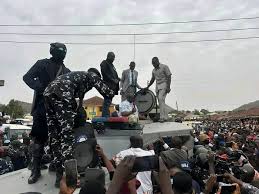
Such efforts must be complemented by proactive government measures. Governor Caleb Mutfwang’s armoured truck appearance at the scene of the crime on Sunday is not one of those measures. Yes, the people were angry at the time, but the optics of the governor addressing them from inside an armoured truck was far from reassuring. While the governor has limited control over the security apparatus in the state, he has significant leverage in seeing that the perpetrators are pursued and found.
As a governor, he must not allow his legacy to be that of the man who appears every time there is a bloodbath in his state, to stand over bloodied corpses, make pitiful faces and hollow promises that the perpetrators will be found. Promises like that must be kept; otherwise, once the people lose faith—and judging from the reactions, they are on the verge of losing it—there will be no going back. The situation must be handled with both commitment and urgency, and he must ensure that the aims of the murderers are thwarted by maintaining peace. The 48-hour curfew was an immediate, painful but necessary intervention. What comes next after that? What comes next after yet another cold-blooded killing?
By Abubakar Adam Ibrahim can be reached through abubakaradam@dailytrust.com Twitter: @Abbakar_himself Whatsapp: 08020621270