
By Guy Martin

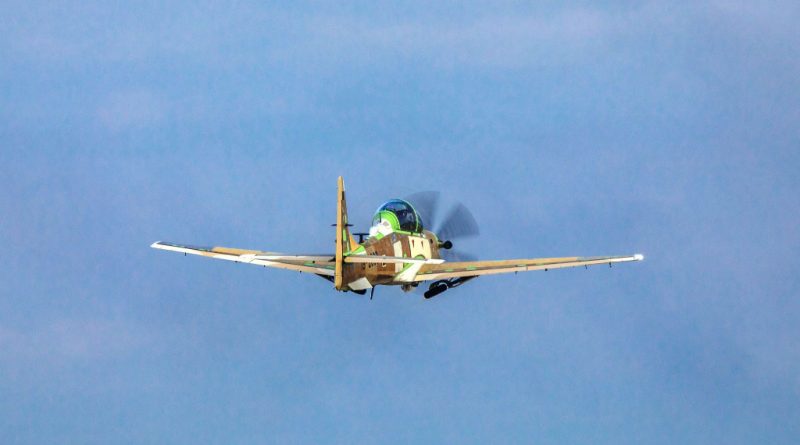
Africa is expected to account for the majority of Super Tucano sales over the next two decades, with Embraer predicting about 150 orders from the continent, where the light attack and trainer turboprop already has a solid customer base.
The aircraft, pitched for light attack, armed reconnaissance, training, and now counter-unmanned aerial system (CUAS) missions, has to date been selected by 22 air forces, with over 300 aircraft ordered, including 39 aircraft added to Embraer’s order book in less than 24 months, with Uruguay (5 aircraft), Panama (4) and the United States’ Sierra Nevada Corporation (1) the latest customers. An undisclosed client ordered four in January – this is believed to be Togo.
Global customers include Angola, Brazil, Burkina Faso, Chile, Colombia, Dominican Republic, Ecuador, Indonesia, Lebanon, Mali, Mauritania, Nigeria, Panama, Paraguay, Philippines, Portugal, Uruguay, United States, and four undisclosed customers. They have accumulated 625 000 flight hours, including 65 000 combat hours.
The Super Tucano has spent two decades leading the light attack market segment, according to Embraer, which provided an update of the programme during a media trip to its Brazilian facilities on 10 June. Over the last seven years, the Super Tucano has secured a 72% market share, with 71 aircraft sold since 2019 compared to seven Paramount Mwaris, eight Textron AT-6 Wolverines, and five Turkish Aerospace Industries Hurkus-Cs.

According to Marcio Monteiro, Chief Marketing Officer for Embraer Defence & Security, the company expects to secure a market share of about 500 aircraft over the next 20 years, with Africa accounting for the majority (28%) of Super Tucano contracts. Demand is also expected to come from South America (23%), the Middle East (18%), Asia (18%), and Europe (13%).
This demand is not just for replacing older aircraft but includes adding new capabilities to air forces. “This platform remains relevant because of its multi-mission capabilities,” Monteiro said.
The Super Tucano is suitable for a wide range of missions such as close air support, air patrol, special operations, air interdiction, forward air controller (FAC), air and tactical coordinator (TAC), armed intelligence, surveillance and reconnaissance (ISR), border surveillance, reconnaissance, air escort, basic, operational and advanced training, transition to air superiority fighters, lead-in fighter and FAC training.
A recent addition to the Super Tucano’s mission list is countering unmanned aerial systems. It does this with electro-optical sensors, data link, laser-guided rockets and/or guns. Last year Embraer partnered with a US company Valkyrie Aero for its Gunslinger AI target classification suite to counter drones. Embraer hopes to have a counter-UAS offering ready soon after demonstrations later this year. The company sees this option as an urgent one to pursue given the proliferation of UAVs in combat theatres, from Iran to Ukraine.

“We continue to expand the A-29’s capabilities to address the most recent challenges faced by many nations worldwide,” said Bosco da Costa Junior, President and CEO of Embraer Defence & Security when announcing the counter-UAS addition to the aircraft’s mission portfolio in November 2025.
“The continued challenges in modern warfare and the recent conflicts worldwide have shown the urgent need for solutions to fight drones. The A-29 is the ideal tool to counter UAS effectively and at low cost, adding to the aircraft’s already extensive mission set that includes close air support, armed reconnaissance, advanced training, and many others,” he said.
Developed in response to the demanding requirements of the Brazilian Air Force (FAB), the A-29 Super Tucano is equipped with a variety of fourth generation avionics and weapons, including an electro-optical/infrared system with laser designator, night vision goggles, secure communications and data-link package. Its systems allow the gathering and sharing of time-critical information, and the aircraft can operate as part of a networked environment.
Armament comprises one 12.7 mm machinegun in each wing. Five hardpoints can carry a maximum external load of 1 550 kilograms. Weapons options include gun pods, bombs, rocket pods, and (on the two outboard stations) air-to-air missiles.
As the Super Tucano was designed from the start to have a light attack capability, it features built-in machinegun mounts, self-sealing fuel tanks and armour in critical locations. Its combat abilities have been well proven in Afghanistan and Colombia, during Amazon protection operations in Brazil and counter-narcotics operations in the Dominican Republic and Brazil, and in Nigeria and other African nations against terrorist organisations.

Monteiro noted many African customers use the Super Tucano for armed reconnaissance and border patrol. He is excited about new Super Tucano orders, with the company’s KC-390 Millenium airlifter and Super Tucano key defence products. Production stands at about 12 A-29s per year, depending on demand.
Aircraft are manufactured in Brazil or by Sierra Nevada Corporation in Jacksonville, Florida, for US Foreign Military Sales (FMS) customers such as Nigeria, Lebanon, and Afghanistan. This facility has also manufactured some white tail aircraft in anticipation of future demand. Monteiro said Embraer is also considering a production line in Portugal.
Guy Martin was in Brazil as a guest of Embraer