
By Chidi Anselm Odinkalu

When he was inaugurated as Nigeria’s elected president on 29 May 2015, Muhammadu Buhari identified three priority issues for his immediate attention. In the order in which he itemized them, these were: insecurity, persistent corruption and energy. President Buhari asserted that he would tackle these “head on” and, switching mental gears into his role as the leader of the All Progressives Congress (APC), promised that “Nigerians will not regret that they have entrusted national responsibility to us.” He got that wrong but let’s not get ahead of the story.
A mere 200 kilometres away, on the same day and at a similar event in Kaduna, at his inauguration as the elected governor of Kaduna State, one of Buhari’s acolytes in the same party, Nasir el-Rufai, identified insecurity as “an obstacle to progress” and promised to “work with law enforcement officials to drastically reduce violent crime” and “insure safety of life and limb.”
By the time both men left office eight years later – one as President and the other as State Governor – they had each and together managed to achieve the exact opposite. What occurred was more than mere abdication on insecurity; it felt like active conspiracy in perpetrating and perpetuating it.
Few communities felt the consequences of this like the Adara. The Adara are found in Munya and Paikoro Local Government Areas (LGAs) of Niger State as well as in Kachia (Kaduna South Senatorial Zone). In Kaduna Central, the Adara are in Chikun and Kajuru LGAs. The experience of the Adara across these state boundaries advertise the failures of government on insecurity, especially since 2015.
As Nigeria prepared for general elections in 2019, Nasir el-Rufai as governor of Kaduna State decided to abolish the Adara Chiefdom and turn it into an Emirate. The Districts and Villages Restructuring (Amendment) Order ostensibly executed by the governor on the third anniversary of his inauguration in May 2019 – with no notice to the affected populations – abolished the stool of the Adara, occupied at the time by the Agwam Adara, Dr. Raphael Maiwada Galadima. In its place, Governor el-Rufai proposed to create a Kachia Chiefdom and a Kajuru Emirate respectively. The order was not gazetted until three months later in August 2018.
Rumours of this development unsettled coexistence among ethnically diverse communities in the Adara Chiefdom. Upon learning about it, the Agwam Adara was reported to have “resisted the change due to the fact that the Adara Chiefdom is dominated by an indigenous Christian population and therefore could not be described as an emirate or appointed an Emir.”
Around 18 October 2019, murderous violence broke out in Kasuwan Magani within the Chiefdom. Over 55 persons were reportedly killed. The state governor visited the following day ostensibly to assess the situation and provide reassurance to a febrile community. The Agwam Adara was also present at the assessment by the Governor, accompanied by his wife. Later in the evening, on his way back to his palace from the events of the day along the Kaduna-Kachia Road, some “armed men intercepted the convoy of the traditional ruler and opened fire, forcing them to stop.” This happened in Maikyali village.
The attackers murdered four persons, including close-protection assets from the Nigerian Police Force attached to the Agwam Adara. They then abducted the traditional ruler with his wife. One week later, the abductors killed the Agwam Adara and “his corpse was moved to Katari, about 85 kilometres between Abuja and Kaduna, before the kidnappers contacted the family of the late chief, informing them where to pick the corpse.” The state governor was absent from his funeral.
The affected communities were not natural strongholds of the governor or his party. In what was projected to be a close contest for the control of the state, marginal shifts in voting or turnout were likely to be dispositive. What looked like a design to create maximum violence in time for the elections of 2019 became a self-fulling prophecy. As the country prepared to head to the polls, Adara-land in Kaduna Central Senatorial Zone descended into an orgy of mass atrocities.
The first reported attacks were in Anguwan Barde in the Maro Ward around 10 February 2019, resulting in the reported killing of 11 persons. The attack on Karamai village about one week later reportedly killed over 40, with many more wounded. A contemporaneous incident in Banono village in Anguwan Aku reportedly killed at least another 26.
Around the same time, Nasir el-Rufai as governor claimed publicly that “66 Fulanis” had been massacred in Kajuru. Both the Police and the National Emergency Management Agency (NEMA) were unable to confirm this and independent fact checkers accused the governor of peddling “misleading narratives.”
One month after the first attack, Unguwan Barde would witness another attack around 11 March 2019, which killed a reported 33 persons. Around the same day, a separate incident in Dogon Noma killed over 72 persons.
In one month, between February and March 2019, the Adara Development Association, (ADA), reported over 148 community members killed or massacred with at least 545 houses destroyed in multiple incidents. The Fulani community put the casualty count among their own community at 131. In what looked like a statistical duel in human tragedy, the government was actively complicit.
In the period from the first reported attack on Anguwan Barde in February 2019 to the second week of April 2026, over 300 documented attacks or atrocity incidents occurred in the Adara communities of Kachia and Kajuru LGAs of Kaduna State, resulting in hundreds of human casualties and billions in destruction. Over 50 villages and settlements have been emptied into internal displacement.
Rather than find the perpetrators and bring them to book, the response of the government was to round up the leadership of the Adara community and lock them away in indefinite pre-trial detention for 112 days. As the Federal High Court would later find, they were consistently refused bail and were only released after the Director of Public Prosecutions found no grounds for their detention or prosecution.
The truth was to manifest five years later after the Adara leaders through the Secretary-General of the ADA, Awemi Dio Maisamari, sued for civil remedies in 2024. In defence of the claim, government claimed that “the Adara Chiefdom and surrounding areas had become centres of violent crimes such as terrorism, banditry, kidnapping, armed robbery and murder, resulting in severe breakdown of law and order.” It further asserted that the scale of these atrocities “required immediate and extraordinary measures to restore peace and security.”
However, the government did not accuse the Adara leadership of having committed any of these crimes. Instead, it said, their mere existence was “prejudicial to peace” and a “significant threat to the stability of Kaduna State as a whole.”
When she eventually decided the case in May 2025, Hauwau Buhari, a judge of the Federal high Court, found as a fact that the arrest and detention of the Adara leaders was “not the result of an impartial, independent police investigation based on credible evidence of a crime, but rather stemmed from a politically motivated complaint.”
On Easter Sunday 2026, brave holdouts among the Adara in Ariko village in Kachia LGA went to church. While there, they were attacked in two different houses of worship by assailants who killed at least five and abducted over 38. Rather than deploy to rescue the victims, the government put out a false claim that they had been rescued. This reprised a similar script from January 2026 when the authorities similarly denied a deadly attack on Kurmin Wali community in which over 177 were abducted.
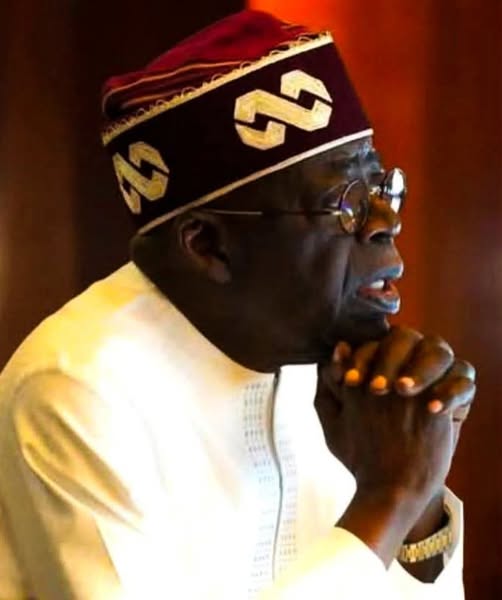
This past week, President Bola Ahmed Tinubu has publicly claimed that in taking over from President Muhammadu Buhari in 2023, he essentially succeeded himself. It was a proud assertion of both policy and political continuity. In saying so, he asserted clear ownership of more than one decade of complicity by Nigeria’s ruling party in the use of atrocity violence for political purposes. That is not the renewed hope he promised. For the Adara People, it has been dystopia on a vampire scale.
A lawyer and a teacher, Odinkalu can be reached at chidi.odinkalu@tufts.edu