

- While the Sahel is often viewed as a localised security challenge, the rapid rise of Islamic State–Sahel Province exposes deepening instability and the growing risk of transnational jihadist expansion.
Published in South African Institute of International Affairs (SAIIA), Research by Ksenia Kumanina

Recommendations
- Revive security cooperation and intelligence sharing: The dismantling of IS-Sahel-linked foreign terrorist fighter cells in Morocco between 2023 and 2025 reveals an entrenched network of recruitment and logistical operations. A joint task force responsible for smuggling oversight would enhance early warning, improve cross-border intelligence flows and prevent the consolidation of trafficking corridors.
- Reinforce defence of critical infrastructure: Jihadi groups are capable of overrunning critical state infrastructure, such as energy facilities, key transportation routes and airports. Anti-raid reinforcements, including intelligence, surveillance and reconnaissance, troop sustainment and quick reaction force units, are vital to maintain control and limit militants’ operational reach.
- Prioritise Nigeria–Niger–Benin corridor: Jihadi expansion into littoral West Africa remains a key regional security threat, with the Nigeria–Niger–Benin corridor becoming the main frontline and transit route for fighters. Bilateral responses are limited without the Alliance of Sahelian States. Parallel efforts should be made to rebuild strained relationships to restore functional intelligence sharing and joint border security.
Executive Summary
On 29 January 2026, Islamic State–Sahel Province (IS-SP) targeted Diori Hamani International Airport in Niger’s capital Niamey, exposing vulnerabilities in the country’s security infrastructure and marking the first use of drones by the group in direct combat. Between 2019 and 2025, IS-SP rapidly expanded in manpower and tactical and operational capabilities, evolving into one of the deadliest IS affiliates in Africa. Its expansion has been driven by the 2021–2023 Sahelian coups d’état, the collapse of the regional security architecture, competition with the al-Qaeda-affiliated Jama’at Nusrat ul-Islam wa al-Muslimin and increasing strategic guidance from IS Core. Unless both the growing presence of foreign terrorist fighters in the region and the near non-existent regional security architecture are addressed, the Sahel could increasingly serve as a platform for transnational jihadi activity.
Introduction
On 29 January 2026, Islamic State–Sahel Province (IS-SP) targeted Diori Hamani International Airport and Air Base 101 in Niamey,1 with no resistance from Nigerien or foreign troops stationed near the capital. This attack shows the extent of the vulnerability of state infrastructure and indicates IS-SP’s growing operational reach. Over the last couple of years, IS-SP has also expanded its footprint to besiege Mali’s Menaka region and spread in northwest Nigeria through its Lakurawa offshoot, becoming one of Africa’s fastest-growing IS affiliates, with the potential to shift from a regional to a transnational threat. This growth is driven by rivalry with al-Qaeda (AQ) affiliated Jama’at Nusrat ul-Islam wa al-Muslimin (JNIM), the collapse of Sahelian security following the 2021–2023 coups and increased guidance from IS Core.
IS-SP consolidated its place in the regional Islamist militant network in 2019, when it was officially recognised by IS Core as a Sahelian branch of the then most active IS African affiliate, Islamic State–West Africa Province (IS-WAP).2 IS’s transnational expansion coincided with the territorial defeat of IS Core in Syria and Iraq in 2019, which shifted its focus to Africa’s permissive operating environment. Although included in the IS transnational network, the IS-SP’s threat level was nowhere near that of IS-WAP at the time, with an estimated manpower of about 200 compared to 3 000, respectively.3 By 2024, IS-SP operationally outperformed IS-WAP,4 becoming one of the deadliest IS affiliates globally with a striking 1 400% increase in manpower to about 3 000.
Escalating JNIM-IS-SP Rivalry
Unlike in other operational theatres characterised by AQ and IS affiliates infighting, JNIM and IS-SP abstained from direct attacks until 2019 in the tri-border area between Mali, Burkina Faso and Niger. The reasons for that lie in the specificities of the Sahelian operational theatre characterised by deep inter-clan relations and years-long personnel crossover within the AQ network in the region.5 With IS-SP recognition, clashes escalated backed by increasingly hostile discourse in IS Core propaganda in 2020 that fuelled ethnic tensions and criticised JNIM’s interpretation of Islamic law.6 As IS-SP grew more ambitious, targeting regional security forces, foreign troops and contesting JNIM-controlled territories, the two entered full-scale competition.
In 2022, attacks targeting civilians in Mali increased by 40%, alongside a growing frequency of clashes between JNIM and IS-SP, while 2023 marked an overall 50% increase in violence among all parties to the conflict compared with 2021.7 This strained existing regional ties and brought IS-SP closer to IS Core operationally. November 2025 marked the highest level of JNIM-IS-SP clashes since 2023, with IS-SP killing over 60 JNIM militants in northeast Burkina Faso.8 If the early 2026 reports of a JNIM commander based in Burkina Faso defecting to IS-SP are confirmed, the infighting will likely escalate even further.
IS-SP executed its deadliest attacks to date amid both heavy international counterterrorism (CT) pressure and JNIM attacks. For example, IS-SP simultaneously targeted villages in Niger’s western Tillabéri region in January 2021, leaving 70 dead.9 This trend was amplified in March 2021, when 137 civilians were killed in a series of attacks in Niger’s western Tahoua region.10 Although these numbers represent only a fraction of IS-SP-inflicted violence, they illustrate its persistent capability for near-simultaneous attacks, which indicates both growing manpower and ongoing tactical training.
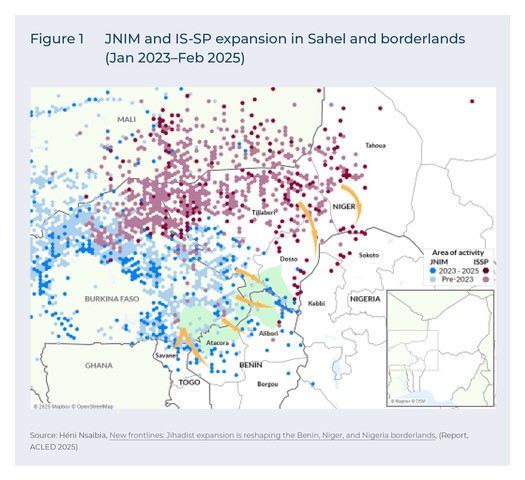
The French CT troop withdrawal after the 2021 Malian coup d’état allowed IS-SP to capitalise on its expansion and fill the security vacuum. At that time, the extent of IS-SP’s strategic importance to the IS global network became more evident, with IS Core designating IS-SP as its independent Sahel-focused affiliate in 2022. IS Core oversight of its global affiliates, at a minimum, suggests inter-affiliate tactical knowledge transfer combined with guidance on the broader strategic-operational outlook. The analysis of all major IS-SP attacks between 2019 and 2025 reveals several patterns.
Governance and Strategic Consolidation
Firstly, IS-SP had shifted from predominantly ethnic-based targeting, rooted in the Fulani–Tuareg conflict, to a more structured approach to territorial control, mirroring such deeply embedded affiliates as IS-WAP. While decreasing the rate of attacks in its strongholds in Mali’s eastern Menaka region since 2022, IS-SP incorporated a range of governance activities: economic control, health services management and dispute resolution through Islamic courts.11 This strategic change proved successful, with IS-SP-controlled territory in Mali doubling by mid-2023,12 displacing JNIM-aligned factions.
Secondly, IS-SP started preaching, likely due to its strengthening connection with IS Core. In particular, the militants began distributing ideological leaflets identical to those spread by IS Core in Syria and Iraq in 2014.13 Thirdly, IS-SP started experimenting with attack methods including weaponised drones, new improvised explosive device types and combined mortar-ground assaults. These tactical choices mirror innovations introduced by IS Core to its other affiliates, including IS-WAP.
In Niger, IS-SP has retained an increasingly offensive posture since 2023, tripling attacks on military patrols in the western regions of Tillabéri, Tahoua and Dosso.14 Considering that IS-SP started moving its activity closer to Niamey in 2025,15 The 29 January 2026 attack could have been in the making long before its execution. Perhaps the most important conclusion that can be drawn from the success of this attack is that, beyond IS-SP’s overall tactical progress, it shows growing inter-affiliate cooperation with IS-WAP.
The latter has continuously used drones for offensive purposes since the 24 December 2024 attack in Wajiroko, Nigeria’s Borno State. Combined with reports of growing logistical connections and the presence of Hausa- and Kanuri-speaking militants on the ground during the attack (Saharan dialects associated with IS-WAP fighters),16 It is very likely that IS-SP was, in some way, assisted in drone assembly by the more operationally advanced IS-WAP.
Foreign Fighter Influx and Transnational Threats
Lastly, IS Core reportedly established transit corridors between southern Europe and the Sahel, calling on foreign terrorist fighters (FTFs) to join IS-SP.17 Moroccan security operations disrupting18 the relocation of FTFs to Mali in October 2023, February 2024 and January 2025 suggests that IS Core is testing the Sahel as an alternative base for transnational attacks. Both JNIM and IS-SP have also gained control over key smuggling networks19 connecting the Sahel to North Africa, which can facilitate the coordination of future transnational attacks and the circulation of FTFs.
Overall, the shift to structural governance, tactical innovation and the attraction of FTFs were all key elements of IS Core’s successful playbook in Syria and Iraq until the coalition crackdown in 2019. Conversely, there is no unified international coalition or functional regional security architecture in the Sahel. As JNIM remains the main actor, IS-SP’s littoral expansion will continue to be constrained. Niger’s exit from the Multinational Joint Task Force in 2025 compromised CT operations and intelligence sharing,20 enabling jihadi expansion along the Niger–Nigeria border. Niamey’s attempts to compensate for overstretched military resources by introducing civilian self-defence militias in August 2025 for deployment to IS-SP’s operational areas are not expected to succeed in the long term.
As the same initiative in Burkina Faso has shown, civilian forces lack training to repel the attacks and instead become easy targets, bolstering jihadi propaganda. Unlike in the Middle East, the West African Islamist militant threat is still viewed as localised or regional at best, with minimal international CT assistance. Further ‘deprioritisation of African security’21 risks triggering another series of coups d’état that would again send the region into a downward spiral, while jihadi groups would use an increasingly volatile political and security landscape to their advantage.
The views expressed in this publication/article are those of the author/s and do not necessarily reflect the views of the South African Institute of International Affairs (SAIIA)