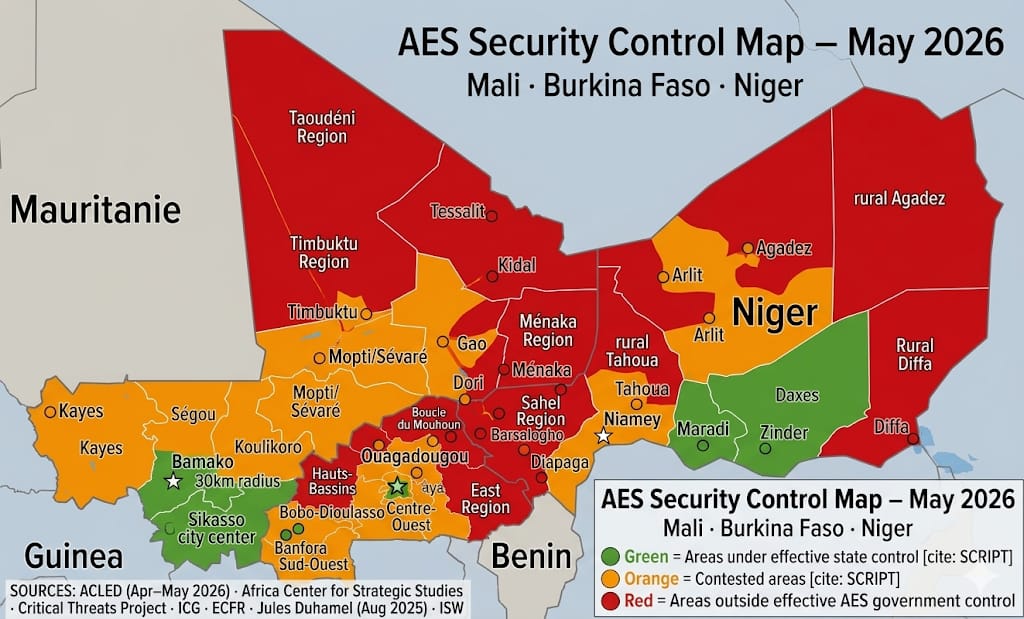

- Five years of military rule in Burkina Faso, Mali, and Niger have produced not sovereignty but collapse. No propaganda can survive the evidence of the May 2026 security map.
By Oumarou Sanou

There is one document that no junta press conference can censor, no hired influencer can spin, and no state television anchor can reframe. It is the current security map of the Sahel, compiled from open-source intelligence platforms and conflict-monitoring organisations, including the Africa Centre for Strategic Studies, ACLED, the Critical Threats Project, the International Crisis Group, and the Institute for the Study of War. That map tells a devastating story. In the blunt, unsparing language of colour-coded territory, it shows that the Alliance of Sahel States (AES) project has failed: not partially, not temporarily, but systematically and comprehensively. It does not argue. It does not editorialise. It simply shows.
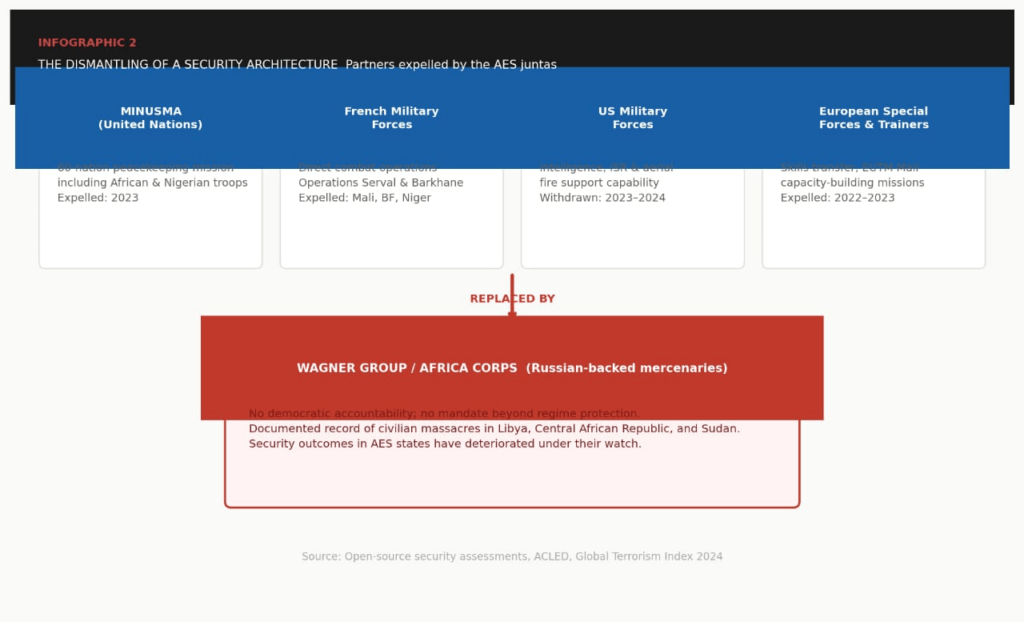
The country-by-country picture is alarming in its specificity. Burkina Faso is the most catastrophic case. Over 90 per cent of the national territory is either under the control of jihadist groups or actively contested. The entire northern, eastern, and central belt, including the Sahel Region, the East Region, and the Boucle du Mouhoun, is red or deeply contested. Captain Ibrahim Traore’s government retains authority in the Ouagadougou city centre, Bobo-Dioulasso, and a scattering of southern towns; nothing more. This is not a government losing ground. It is a government that has already lost it. In practical terms, this is state collapse, even if not yet formally declared.
Mali has crossed a point of strategic irreversibility in the north. Taoudeni, Timbuktu, and Menaka are gone. Bamako’s security perimeter has contracted to a 30-kilometre radius, a damning indicator of how drastically the capital’s envelope has shrunk. The centre, covering Mopti and Gao, remains a deeply contested warzone, with the state and armed groups competing for territorial authority. Only a narrow western strip around Bamako and Kayes, and Sikasso in the south, remains under effective government control.
Niger is the relative exception: Niamey, Zinder, and Maradi remain in the green zone. But rural Diffa and rural Agadez are already red, and Tahoua is contested. Niger is following the same trajectory as its neighbours, running roughly two to three years behind. The overarching reality of the security landscape across all three AES states is the same: the juntas promised security and delivered the opposite — fragmentation. Secondly, isolationist militarism has failed to contain a transnational threat. Thirdly, propaganda can no longer conceal the widening gap between rhetoric and reality.
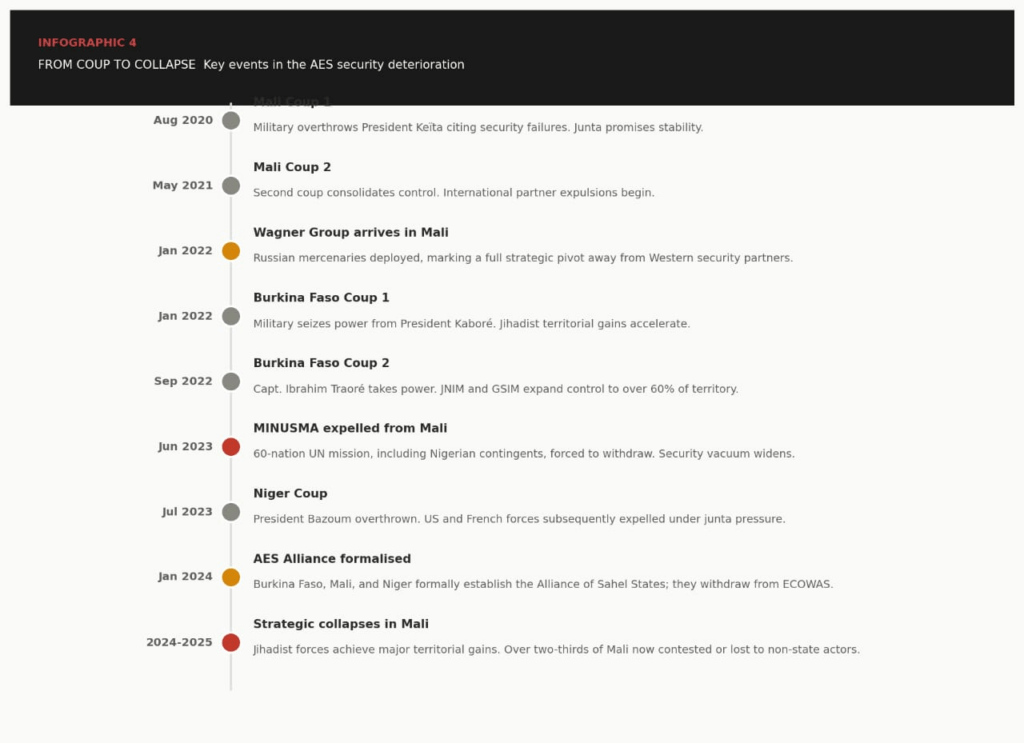
When soldiers seized power in Mali in 2020, Burkina Faso in 2022, and Niger in 2023, they advanced the same essential argument: that civilian governments had failed, that foreign partners had become liabilities, and that only military rule could restore sovereignty, dignity, and territorial integrity. Five years later, the verdict is written across the map. The Sahel is not stabilising. It is fragmenting. And the junta bears direct responsibility for accelerating that fragmentation.
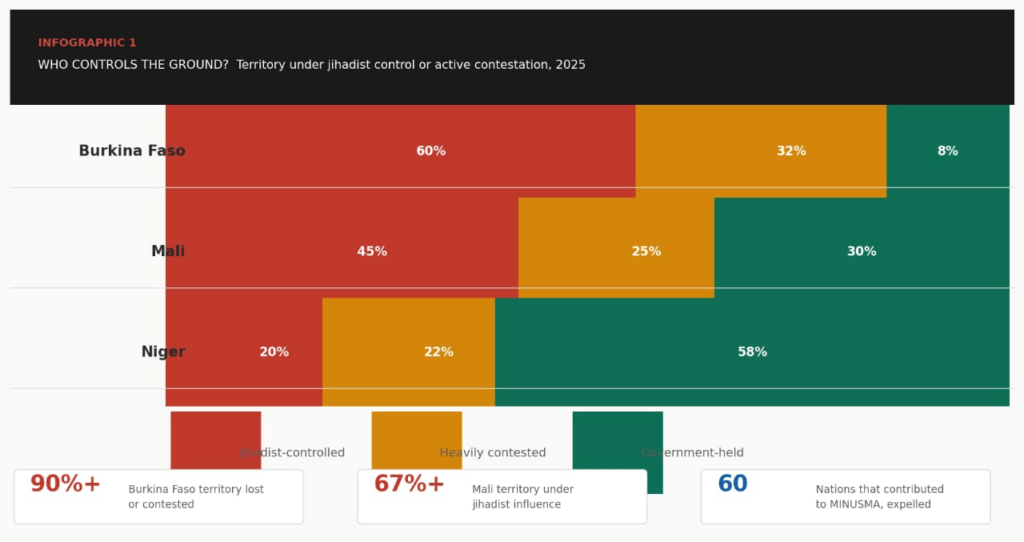
One of the most consequential failures of the AES project lies in the belief that a deeply complex, transnational security crisis could be defeated through isolation, militarised nationalism, and anti-Western rhetoric. The junta did not merely fail to improve on their predecessors; they dismantled the cooperative security architecture painstakingly constructed over the years to contain extremist expansion. MINUSMA, the United Nations stabilisation mission in Mali, incorporated contributions from dozens of countries, including African and Nigerian contingents; it was expelled in 2023. French military operations were terminated. American intelligence and aerial support structures were withdrawn. European special forces and training missions ended. In their place came the Wagner Group, later rebranded as Africa Corps: a mercenary network with no democratic accountability, no long-term development agenda, and an established record of civilian abuses stretching from Libya to the Central African Republic and Sudan.
The fall of Kidal crystallised the contradiction with brutal clarity. Celebrated in 2023 as proof that expelling Western forces and embracing Moscow was an act of strategic genius, Kidal instead became a monument to strategic illusion: Africa Corps personnel reportedly negotiated their own withdrawal, while Malian troops were left isolated and exposed. The city, once paraded as evidence of restored sovereignty, became evidence of betrayed sovereignty. Years of carefully constructed propaganda collapsed in a single moment of contact with the battlefield.
Yet the failure runs deeper than military reversals. Terrorism has never been solely a military problem. It thrives where governance collapses, economies deteriorate, institutions weaken, and citizens lose hope.
Poverty, unemployment, corruption, weak border control, and absent public services remain the central drivers of extremist recruitment across the Sahel. On every one of these fronts, the juntas have failed to deliver any measurable improvement. Economic uncertainty has deepened. Investor confidence has evaporated. Media freedoms have been extinguished. Civil society increasingly operates under direct pressure. Democratic institutions, already fragile, have been fully subordinated to barracks authority. Regimes that promised the discipline and efficiency of emergency governance have instead exposed, with painful consistency, that soldiers without governing experience do not know how to govern.
Moreso, there is a profound irony in the junta’s claim to Pan-Africanism. The doctrine, as conceived by its founding thinkers, was rooted in solidarity, integration, and shared prosperity; not a licence for paranoid nationalism that severs ties with African neighbours, rejects regional cooperation, and sustains itself through information control and manufactured grievance. One can hold an audience captive on anger and resentment for a time. People ultimately require food, security, healthcare, and a future. Slogans, as the map makes plain, do not fill granaries or secure borders.
The consequences of this failure have long since ceased to respect national boundaries. The Sahel is now a sanctuary in which jihadist organisations regroup, recruit, train, and plan operations far beyond the AES perimeter. Benin, Togo, Ghana, and Côte d’Ivoire face mounting pressure along their northern frontiers. Nigeria, already confronting multiple security emergencies, faces heightened risks from arms trafficking, militant mobility, and cross-border radicalisation flowing freely across porous boundaries. What was once dismissed as alarmist conjecture, the emergence of a contiguous Islamist corridor across the Sahel, is now discussed by serious analysts not as a remote possibility but as a live and advancing threat. Instead of a Pan-Africanism of prosperity, the juntas have produced what must plainly be called a terrorist Pan-Africanism: a transnational network of instability exported to an entire neighbourhood.
None of this means previous international interventions were without fault; they were not. France, ECOWAS, the United Nations, and Western partners made consequential errors, and many Africans held entirely legitimate grievances about the terms of external engagement.
But replacing imperfect cooperation with strategic isolation and mercenary dependence has produced demonstrably worse outcomes for the very populations those juntas claimed to liberate. That is not an argument for foreign dominance; it is an argument for African-led, accountable, and genuinely cooperative security of the kind that authentic Pan-Africanism has always demanded.
ECOWAS and the international community cannot afford to wait for this trajectory to run its course. The immediate priorities are clear: reinforce the security capacity of coastal states, restore regional intelligence-sharing frameworks, and develop credible contingency plans for scenarios that are no longer theoretical. The longer-term priority is equally plain: support any government that emerges from the ruins of these juntas with the legitimacy, institutional capacity, and regional relationships needed to rebuild. That support must be conditioned on African leadership, civilian accountability, and the categorical exclusion of mercenaries, of every nationality and flag, from any future stabilisation architecture in West Africa.
Sovereignty is not measured by the vehemence of anti-Western slogans, the spectacle of military parades, or the confidence of televised communiques. It is measured by whether a state can protect its citizens, secure its territory, and offer its people a future worth believing in. The security map of the Sahel in May 2026 delivers that verdict with clarity and honesty that no junta broadcast has matched. The question now is whether this region’s leaders and the broader African community are finally prepared to read it honestly and act accordingly, before the cost of continued inaction becomes truly irreversible.
Oumarou Sanou is a social critic and researcher specialising in governance, security, and political transitions in the Sahel. He writes on geopolitics, regional stability, and African leadership dynamics. Contact: sanououmarou386@gmail.com