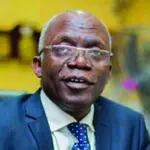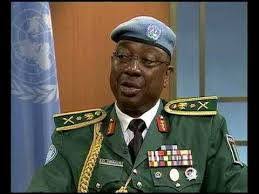

Lieutenant General Isaac Chukwukadibia Obiakor, one of Nigeria’s finest military officers and the first Military Adviser to the United Nations (UN) Department of Peacekeeping Operations to hold the rank of Assistant Secretary-General of the United Nations, is dead. He died at 75.

Family sources confirmed that General Obiakor died on Wednesday after suffering a massive stroke on Sunday.
His death has thrown the Nigerian military family and hometown of Awka, Anambra State in mourning.
A well-respected professional and Commander, General Obiakor was born on February 18, 1951 in Zaria, Kaduna State into the family of Mr. and Mrs. Robert Echetebu Obiakor. His father was a fireman at the Nigerian Railway Corporation.
He attended the Nigerian Military School (NMS), Zaria, from January 1963 and by Class 3, was already the school high jumper and played basketball. The January 1966 coup took place while he was still a student (‘Boy Soldier’) there.
On 27 July 1966, he was in transit to the East with other ‘Boy Soldiers’ of the Nigerian Military School unaware that the counter-coup was already underway. Then Military Governor of the Eastern Region, Colonel Chukwuemeka Odumegwu-Ojukwu ordered that the boys should not return to the North and directed them to government schools in the East. Obiakor found himself at Government College Umuahia, where he continued his education until 1967.
When the civil war came in July 6, 1967, he was caught in it. Obiakor fought on the Biafran side.
When the war ended on January 15, 1970, he made his way back to Nigerian Military School, Zaria. The then Commandant intervened to ensure that all the NMS boys who had fought on the Biafran side were released without delay and allowed to return to the school to complete their training. That single act of institutional grace changed the course of his life.
He returned to NMS Zaria in April 1970, wrote his School Certificate examinations, and passed the entrance examination into the Nigerian Defence Academy (NDA) and was admitted as a member of the 10th Regular Course of the NDA. He commissioned into the Nigerian Army in 1973.
He held various appointments in the course of his career including serving in the ECOWAS Military Group (ECOMOG) in Liberia.
General Obiakor later served as the General Officer Commanding (GOC), 2nd Mechanised Division, Nigerian Army, Ibadan and Chief of Administration, Headquarters Nigerian Army.
In January 2006, then UN Secretary-General Kofi Annan appointed him Force Commander of the United Nations Mission in Liberia (UNMIL), returning him back to the same country he first served under ECOMOG in the 1990s. But this time, he commanded the entire UN Mission responsible for keeping the peace in post-war Liberia.
On 28 May 2008, then UN Secretary-General Ban Ki-moon appointed him Military Adviser for United Nations Peacekeeping Operations (UNPKOs) worldwide at the UN Department of Peacekeeping Operations, headquarters New York.
In that capacity, Obiakor became the first ever Military Adviser to the UN Department of Peacekeeping Operations to also hold the rank of Assistant Secretary-General of the United Nations.
As the Military officer at the apex of the global peacekeeping system, Obiakor advised the UN Secretary-General directly on military matters across every conflict zone the United Nations was operating in.
He held that position until September 2010.
Widely recognized as one of the longest-serving Generals in the modern Nigerian military, he retired from the Nigerian Army on June 24, 2011.
In retirement, he later chaired the UN Boards of Inquiry into the downing of a UN plane in South Sudan, the killing of Burundian refugees in the Democratic Republic of Congo (DRC), and into the destruction of humanitarian facilities in northwest Syria.
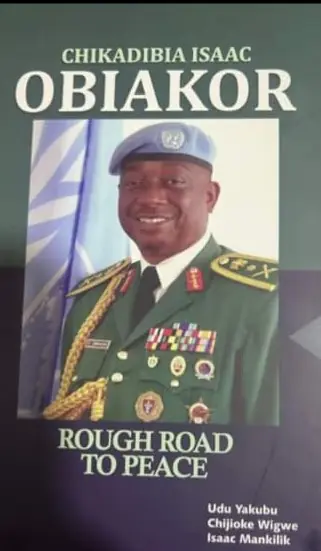
The National Defence College (NDC) Abuja published a biography of his life and career titled “Rough Road to Peace.” The book chronicles General Obiakor’s life from the Biafran War to his ascent as one of the highest-ranking Nigerian Generals in United Nations Peacekeeping and notable contributions to global security.