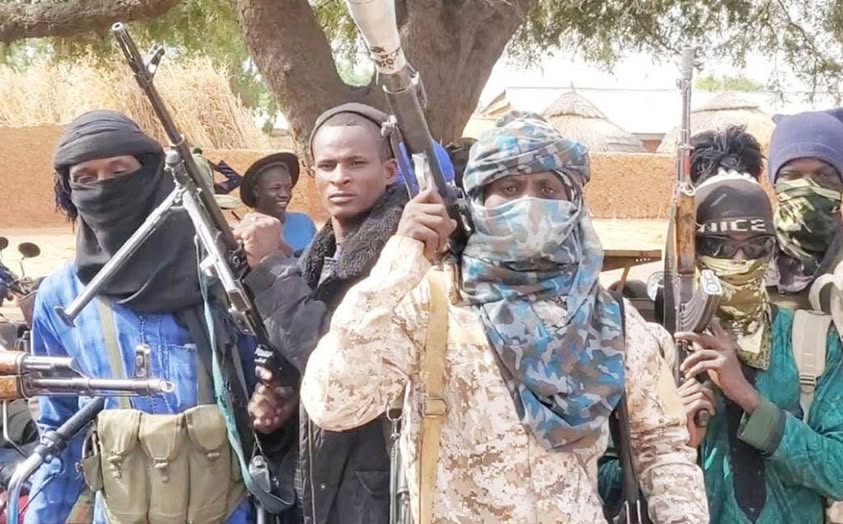


THE predawn abduction of 40 worshippers from a mosque in Zamfara State on September 15 amid negotiations was the latest humiliating proof that offering olive branches to terrorists is futile.
Supposed peace talks were ongoing when the marauders surrounded a mosque in Gidan Turbe village at 5.30 am and abducted the worshippers at gunpoint.
During early morning prayers on Friday, the bandits boldly carried out a similar invasion at Yandoto, Tsafe LGA in Zamfara. They massacred five worshippers and abducted several others.
Zamfara’s appeasement policy is not an isolated case. Overtures to these mindless killers are common in neighbouring Katsina State and beyond, to no lasting effect.
Terrorists do not care about peace deals. Pardons and amnesties do not change them. Neither does de-radicalisation. Nor absorbing them into the security forces. Their only agenda is plunder, extortion, killings, and a caliphate. Therefore, state governments should no longer engage in “peace” negotiations with terrorists. Instead, Nigerian troops should crush them decisively.
The futile dalliance with bandits exposes Nigeria’s worst frailties: inability to understand that negotiating with bandits amounts to a surrender.
The government’s primary duty is not to haggle with murderers. It is to shield citizens from arsonists and extortionists who burn villages and rape communities. The 1999 Constitution projects a country where “security of life and property” is guaranteed. But, in 2025, Nigeria tries to buy protection from the very killers it should be hunting down.
In 2022, an emir in Zamfara conferred a chieftaincy title on a notorious bandit leader. In Katsina, the government appealed to bandits to lay down their arms for amnesty.
This is not tact or diplomacy. It is a surrender to non-state actors that yields no fruit. Rather, it leaves behind a trail of abducted children, widowed mothers, and shattered economies.
The bandits scoff at the naivety of peace deals because they know the truth: they have no central command, no unified hierarchy to broker with, no single warlord to hold accountable.
They are loosely affiliated gangs—some Fulani herder militias, others opportunistic rustlers, kidnappers and robbers, all driven by greed. They are scattered across the North-West and Middle Belt. Negotiate with one group in Katsina, and another one strikes in Zamfara.
So, peace deals with bandits are pointless, a charade that emboldens the killers while eroding public trust in the security system.
These are not war-wearied men seeking a handshake of truce. Their ideology is dominion. For the jihadist group Boko Haram and its splinter, ISWAP, the endgame is a caliphate carved out of Nigeria, where Sharia is not debated but enforced at gunpoint.
They reject the secular state not through ballots but by beheadings, viewing compromise as apostasy.
Boko Haram’s founder, Muhammad Yusuf, preached that Western education is satanic; his successors, Abubakar Shekau and the ISWAP faction, have turned that venom into a genocidal crusade.
Since 2009, they have slaughtered over 350,000, with Borno State alone bearing 38,000 fatalities from 2011 to 2023. The number of traumatised survivors is higher.
The displaced are estimated at over 2.3 million, crammed into IDP camps or fleeing to Chad, Cameroon, and the Niger Republic. In Borno, a recent overnight raid reportedly claimed 60 lives in a single village.
The dead are not the only casualties. The terrorists have foreclosed the futures of many, shutting down over 1,500 schools since 2014, kidnapping 276 Chibok girls in one infamous swoop and countless others since.
An entire generation of children – mostly girls – have been robbed of literacy, condemned to poverty and exploitation.
Boko Haram and bandits have chased farmers from their fields, blockading farmlands in Borno, Yobe, and Adamawa with threats of execution, and extracting tolls from some, with the consequences reverberating at dinner tables far afield.
In January, ISWAP massacred over 40 fishermen and farmers around Lake Chad, leaving dozens wounded. Such assaults have left Africa’s most populous country reeling on the edge of food insecurity.
Nigeria, once a food basket, now imports staples.
On September 19, Benue bled again. Fulani militias ambushed a joint patrol of Operation Zenda, the state Civil Protection Guard, and the Special Intervention Squad at Agu Centre, on the Katsina-Ala/Ukum border.
Three operatives fell first; eight more vanished into the bush. By September 22, their bodies surfaced, bringing the tally to 11 dead: 10 police officers and one guard. This came in a year where Benue lost about 76 security personnel to such savagery. To assuage losses, some widows were gifted N5 million each, while thousands more families grieve uncompensated.
A member of the House of Representatives, Terseer Ugbor, representing Kwande/Ushongo, estimates that over 40 per cent of the state’s farmlands have been taken over by Fulani bandits.
The government fails because it misdiagnoses cancer as rashes, confusing mindless murderers with environmental agitators of the Niger Delta. They are not the same.
Terrorist groups like Boko Haram have an insatiable appetite for chaos.
Its splinter, ISWAP, deploys weaponised drones, striking military bases before deploying ground forces. These are not illiterate herders; they are adaptive jihadists, black-market savvy, gleaning from ISIS’s playbook.
Others are simply in it for the money, exploiting Nigeria’s weak security system and an abundance of unpoliced communities.
So, Nigeria’s troops must counter them with technology and superior firepower in this asymmetrical warfare.
But tech alone won’t suffice. Nigeria must root out the blood-soaked gangs by cutting their supply lines and starving them of funds.
Their collaborators and enablers in various communities must be fished out and dealt with. Deals and amnesties won’t work.
Colombia dismantled the Revolutionary Armed Forces of Colombia that terrorised the country for five decades, killing 220,000, displacing 5.7 million, and fuelling a narcotic nightmare.
FARC, like Boko Haram, was ideological, rural-rooted, and funded by extortion and drugs. Early peace talks flopped; violence escalated. Then came Plan Colombia in 2000: a full-scale United States-backed onslaught with a $10 billion war chest.
With 300,000 troops, aerial herbicide spray on coca fields, and bolstered intelligence, the terrorists were on the back foot. President Álvaro Uribe’s “Democratic Security” policy flooded FARC heartlands, eliminating leaders like Raul Reyes in 2008.
The above editorial was published on Sunday September 28, 2025