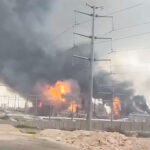

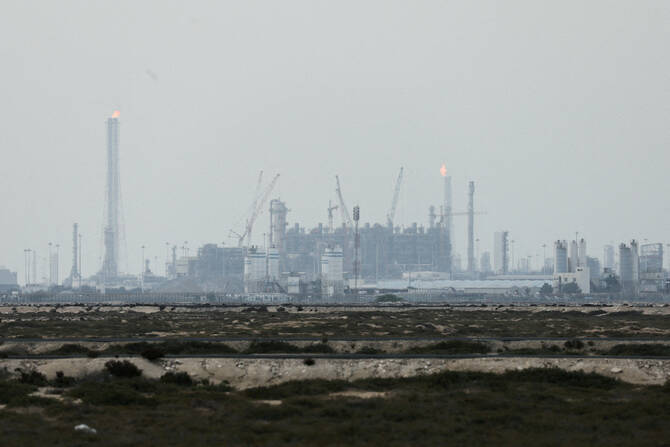
Qatar’s state oil giant QatarEnergy said on Wednesday that Iranian missile attacks on Ras Laffan, the site of the country’s core LNG processing operations, caused “extensive damage,” while the UAE shut gas facilities after intercepting missiles early on Thursday.

The attacks, which drew a furious response from US President Donald Trump, came hours after Iran issued evacuation warnings for several oil facilities across Saudi Arabia, the UAE and Qatar, following strikes on its own energy infrastructure in South Pars and Asaluyeh. QatarEnergy, the world’s second-largest LNG exporter, said in a statement that its emergency response team was deployed immediately to contain fires caused by the attack.
No casualties were reported and all personnel were accounted for, it added. Ras Laffan, located 80 km (50 miles) north of Doha, is an energy-industry hub and hosts several international companies including Shell, the world’s biggest LNG trader.
“We are currently assessing any potential impact on any asset operated or utilized by Shell in Ras Laffan Industrial City and will provide further information in due course,” a Shell spokesperson said. The energy major has a 30 percent stake in a 7.8 million-metric-tons-a-year LNG facility and investments in yet-to-produce LNG plants at Ras Laffan. It also has a 100 percent interest in the Pearl gas-to-liquids plant in the hub, with capacity to process up to 1.6 billion cubic feet per day of wellhead gas.
QatarEnergy said the Pearl gas-to-liquids facility had suffered extensive damage. Several LNG facilities were hit by missile attacks in the early hours of Thursday, causing “sizeable fires” and further damage, it added.
Trump threatens response
Qatar produces 77 million metric tons of LNG annually and is the world’s second-largest exporter of the fuel used in power generation and industries. The Laffan refinery primarily processes condensate into refined products including aviation fuel.
In a statement on social media, Trump warned Iran not to attack Qatari LNG facilities again and threatened to “massively blow up the entirety of the South Pars Gas Field” if it did so. He said Israel had attacked South Pars without informing Qatar or the United States.
Qatar’s foreign ministry told Iran’s security and military attaches to leave the country within 24 hours and declared them “persona non grata.” In a statement, the ministry condemned the attack on Ras Laffan as a “direct threat” to Qatar’s national security and accused Iran of taking an “irresponsible approach.”
Saul Kavonic, head of research at Australia’s MST Marquee, said attacks on Ras Laffan “could cause a lasting global gas shortage, but this won’t pressure the Trump administration because the US benefits economically from high global gas prices.”
Gas facilities shut down in UAE
In the UAE, authorities said they were responding to incidents at the Habshan gas facilities and at the Bab oil field caused by falling debris from intercepted missiles.
The gas facilities were shut down and no injuries were reported, the Abu Dhabi Media Office said.
The Habshan complex, operated by Abu Dhabi state oil giant ADNOC, is one of the world’s largest gas processing facilities, comprising five plants with a total capacity of 6.1 billion standard cubic feet per day (bscfd), according to ADNOC.
Meanwhile, Saudi Arabia’s Foreign Minister Prince Faisal bin Farhan warned Thursday that the Kingdom’s restraint in the face of escalating Iranian attacks “is not unlimited,” signaling that military action remains on the table — as Arab and Islamic states issued a unified call for Tehran to halt its aggression.
“The Kingdom and its partners possess significant capabilities, and the patience we have shown is not unlimited. It could be a day, two days, or a week — I will not say,” he told reporters following an emergency meeting of foreign ministers in Riyadh.
In some of his strongest remarks since the conflict began, Prince Faisal said Saudi Arabia “reserves the right to take military action if deemed necessary,” warning that continued Iranian escalation would carry political and moral consequences.
He added that the “little trust” rebuilt with Tehran after the 2023 restoration of diplomatic ties “has been completely shattered,” cautioning that further attacks could leave “almost nothing” to salvage in the relationship.
His warning underscored a broader regional shift, with foreign ministers from Arab and Islamic countries jointly signaling that patience with Tehran is wearing thin.
In a statement issued after the Riyadh meeting, ministers from Saudi Arabia, the UAE, Qatar, Kuwait, Bahrain, Egypt, Jordan, Syria, Türkiye, Pakistan, Azerbaijan and Lebanon called on Iran to immediately halt its attacks, warning that the future of relations depends on respect for sovereignty and non-interference.
They condemned what they described as deliberate missile and drone strikes targeting civilian infrastructure — including oil facilities, airports, residential areas and diplomatic premises — and said such actions “cannot be justified under any pretext.”
The ministers also affirmed the right of affected states to defend themselves in accordance with Article 51 of the UN Charter, while urging Iran to adhere to international law and de-escalate.
Since February 28, Iran has launched waves of missiles and armed drones targeting Saudi Arabia and neighboring Gulf states — including the UAE, Kuwait, Bahrain and Qatar — in what Tehran says is retaliation for US-Israeli strikes on targets inside Iran.
The conflict intensified on Wednesday after Iran accused Israel of striking facilities at the South Pars gas field and vowed to target energy infrastructure across the Gulf. Authorities in Saudi Arabia, Qatar and the UAE reported attacks on oil and gas facilities the same day.
In the Saudi capital, air defenses intercepted four ballistic missiles targeting Riyadh, according to the Ministry of Defense. Debris from intercepted projectiles fell near a refinery south of the city, while residents reported hearing explosions and receiving emergency alerts, marking a rare moment when the conflict was directly felt in the capital.
Saudi defense officials say air defenses have intercepted at least 457 drones, 40 ballistic missiles and seven cruise missiles since the start of the escalation. The UAE has reportedly faced an even higher volume of attacks, while other Gulf states have also been hit.
Prince Faisal said the strikes appeared to have been “prepared in advance” and accused Iran of carrying out “premeditated hostile actions” against its neighbors, both directly and through regional proxies.
He also confirmed that two Saudi oil refineries were targeted, contradicting earlier claims by Iran’s ambassador that strikes were limited to US assets.
“Iran has not dealt with its neighbors in the spirit of brotherhood, but with a hostile view,” he said, adding that Gulf states had repeatedly urged Tehran to halt support for armed groups and ensure the security of maritime navigation.
The ministers echoed those concerns, warning against threats to international shipping and urging Iran to refrain from actions that could disrupt navigation in the Strait of Hormuz and the Bab el-Mandeb, two of the world’s most critical maritime chokepoints.
Iran has been accused of backing the Houthi movement, which has targeted commercial shipping in the Red Sea, as well as Hezbollah, whose confrontation with Israel has intensified the crisis in Lebanon.
Israeli strikes in Lebanon since early March — triggered by Hezbollah attacks in support of Iran — have killed at least 968 people and wounded more than 2,400, according to the Associated Press, citing Lebanon’s health ministry. More than one million people have been displaced amid widespread evacuation warnings.
Despite the escalation, Prince Faisal said Saudi Arabia still prefers diplomacy, but warned that continued attacks could close the door to de-escalation.
Written with reports from Arab News