
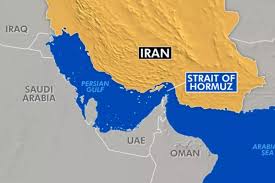
Iran said Friday it fully reopened the Strait of Hormuz to commercial vessels, but US President Donald Trump said the American blockade on Iranian ships and ports “will remain in full force” until Tehran reaches a deal with the US, including on its nuclear program.

Iranian Foreign Minister Abbas Araghchi posted on X that the crucial waterway through which about 20 percent of the world’s oil is shipped was now fully open to commercial vessels, as a 10-day truce between Israel and the Iran-backed Hezbollah militant group in Lebanon appeared to hold.
Trump initially celebrated, posting on social media that Iran announced the strait “is fully open and ready for full passage.” But minutes later, he issued another post saying the US Navy’s blockade would continue until “UNTIL SUCH TIME AS OUR TRANSACTION WITH IRAN IS 100% COMPLETE.”
During a string of social media posts indicating a peace deal with Tehran was near, Trump said Iran had agreed to never again shut the Strait of Hormuz.
“Iran has agreed to never close the Strait of Hormuz again. It will no longer be used as a weapon against the World,” Trump said on his Truth Social network, after Iran earlier said the crucial sea passage would remain open during a Middle East ceasefire.
He also denied that any money would be involved in a deal with Iran over its nuclear program, after an Axios report that Washington was considering a $20 billion cash-for-uranium exchange.
“The U.S.A. will get all Nuclear ‘Dust,’ created by our great B2 Bombers – No money will exchange hands in any way, shape, or form,” Trump said on Truth Social.
Trump imposed the blockade earlier this week after Iran restricted traffic through the strait due to fighting in Lebanon, which Iran claimed to be a breach of the Pakistan-brokered ceasefire reached between the US, Israel and Iran.
At the time Trump said the blockade would enforce an “all or none” policy in hopes of pressuring Iran to reopen the strait.
Trump’s decision to continue the blockade despite Iran’s announcement appeared aimed at sustaining pressure on Tehran as the fate of the two-week ceasefire reached last week remains uncertain. Direct talks between the US and Iran last weekend were inconclusive, as the two nations differed over Iran’s nuclear program and other sticking points.
Oil prices fell on hopes of a deal. The head of the International Energy Agency had warned that energy shocks could get worse if the strait did not reopen. Iran closed the crucial waterway shortly after the war began.
Trump also denied Friday that any money would be involved in a deal with Iran over its nuclear program, after an Axios report that Washington was considering a $20 billion cash-for-uranium exchange.
“The U.S.A will get all Nuclear ‘Dust,’ created by our great B2 Bombers – No money will exchange hands in any way, shape, or form,” Trump said on his Truth Social network.
Trump says Israel banned from bombing Lebanon
Trump said on Friday that the United States has banned Israel from further bombing in Lebanon, using an atypically harsher tone than usual with the longtime US ally Israel.
“Israel will not be bombing Lebanon any longer. They are PROHIBITED from doing so by the USA. Enough is enough!!!” Trump said in a social media post.
Trump also said any deal the United States reaches with Iran “is in no way subject to Lebanon” but the US will “deal with” the militant Hezbollah situation in an appropriate manner.
Trump’s posts came after Araghchi said that passage for all commercial vessels through the Strait of Hormuz is “declared completely open” for the remaining period of the ceasefire.
Pakistan army chief meets with Iranian parliament speaker
Pakistan’s army chief met Thursday with Iran’s parliament speaker as part of efforts to press for an extension to a ceasefire that has paused almost seven weeks of war between Israel, the US and Iran.
Even as the US blockade on Iranian ports and renewed Iranian threats strained the ceasefire, regional officials reported progress, telling AP the United States and Iran had an “in-principle agreement” to extend it to allow for more diplomacy. They spoke on condition of anonymity to discuss sensitive negotiations.
Mediators are pushing for a compromise on three main sticking points: Iran’s nuclear program, the Strait of Hormuz and compensation for wartime damages, according to a regional official involved in the mediation efforts.
Trump suggested the ceasefire could be extended.
“If we’re close to a deal, would I extend?” Trump said in an exchange with reporters. “Yeah, I would do that.”
With AP, Reuters and AFP