

The Desk – Finance, Policy & the View from the Street By Kemi Adeosun
Three ministers left government this week. Wale Edun at Finance, Ahmed Dangiwa at Housing, Adebayo Adelabu at Power. I have been where they have been, and I can only wish all three well. Serving Nigeria is a privilege — full stop.
The reform agenda does not pack itself into boxes and leave with the minister. What has always been scarce in Nigeria is not the vision but execution, The baton has changed hands. The course has not. What matters now is the sprint.
As ex Ministers, the convoy disappears, the phone goes silent And life – ordinary, humbling, clarifying life – resumes. Which brings me to last week, and two conversations that will not leave me alone.
What an entrepreneur taught me — and What I Did With It
My Nidacity podcast conversation with Femi Okenla ran longer than planned, as the honest ones tend to do. It was a snapshot of what enterprise looks like in Nigeria today — unvarnished, resilient, and quietly furious in the way only seasoned entrepreneurs can be. An MBA class, without the PowerPoint. What he did not cover is probably not worth knowing. He spoke about banks, about staff, about dollar-denominated liabilities sitting on a naira revenue base. When he started talking about power, it triggered a thread that demanded more research on my part.
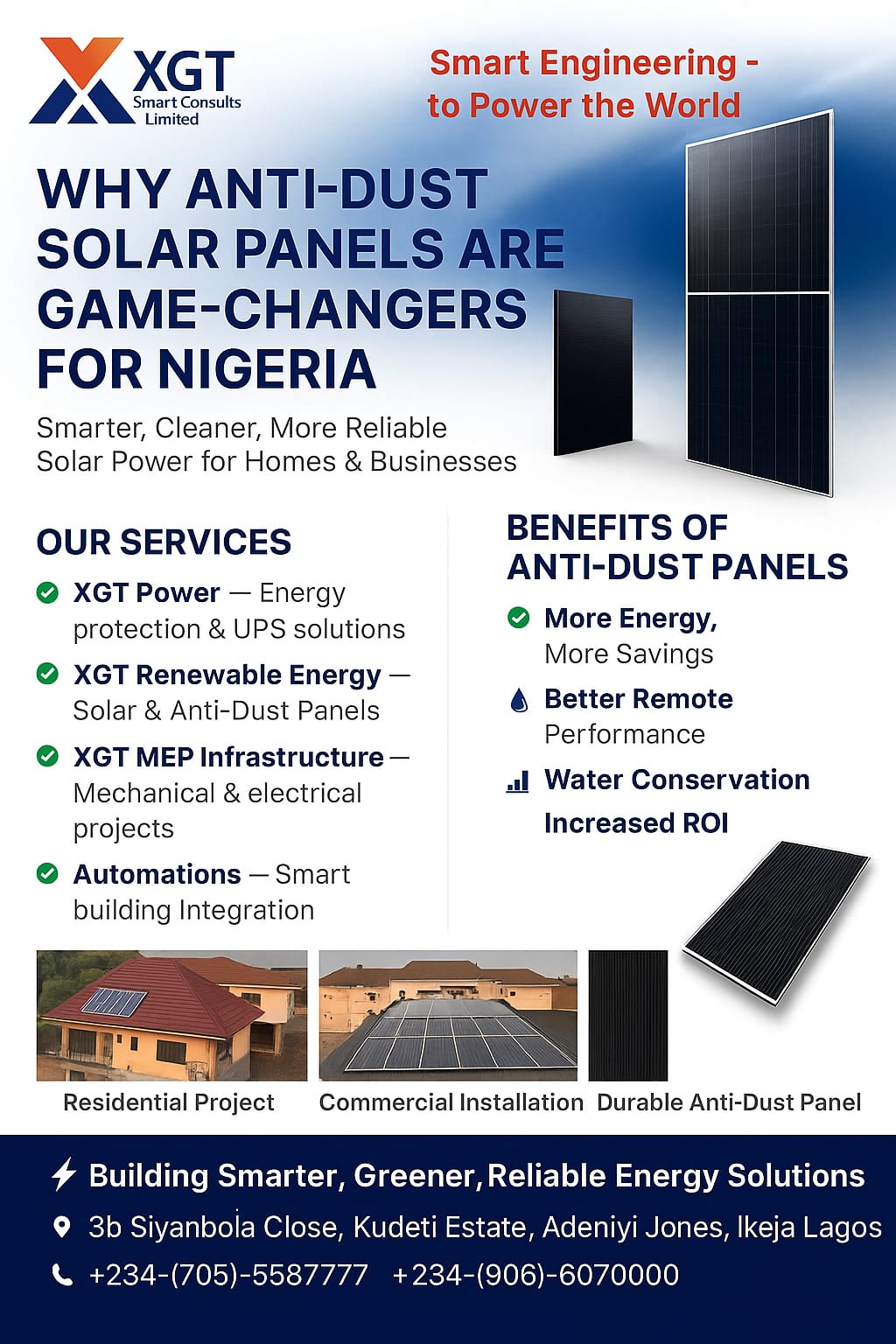
The numbers deserve to be stated without editorial softening. A Band A electricity customer — theoretically guaranteed twenty hours of supply per day — currently pays ₦200 per kilowatt-hour. That is the cost-reflective tariff, unsubsidised, and in principle correctly priced. Now set it against the Levelised Cost of Energy from a fully installed commercial solar system: approximately ₦80–120 per kilowatt-hour depending on scale and financing structure, with capital cost, batteries, and all financing absorbed — roughly 60 percent of the grid price. Then compare diesel-generated power, which runs north of ₦400/kWh, and the picture becomes undeniable.
The upfront investment runs from ₦3 million to ₦20 million depending on scale, with payback periods of two to four years at current grid and diesel prices. With a useful life of ten years, the economics become elementary: post payback, the sun works for nothing.
According to the Global Solar Council’s Africa Market Outlook for Solar PV 2026–2029, published February 3, 2026, Nigeria installed 803 megawatts of new solar capacity in 2025 — a rise of 141 percent on the previous year, making this country Africa’s second-largest solar market behind South Africa. Of that, approximately 96 percent is off-grid: rooftop panels, solar home systems, commercial installations, and private mini-grids. The private sector has not waited for the national grid to reform itself. It has built around it.
The Framework the New Minister Should Read
Professor Justin Yifu Lin is the former Chief Economist of the World Bank and the architect of New Structural Economics — a framework that should be required reading for every Minister. He has long argued that infrastructure investment in developing economies must flow first toward productive sectors. Not because residential consumers do not matter, but because the value created by a functioning enterprise — the jobs, the taxes, the supply chain it anchors — is what eventually funds universal coverage. You do not wait for a perfect grid before economic activity begins. You concentrate reliability where output is generated and let output pay for expansion.
The Band A tariff was, in its own way, an attempt to apply precisely this logic. Charge commercial users the honest cost of power; use that revenue to cross-subsidise lower bands and fund grid improvement. Sound in theory. The problem was that supply never rose to meet the demand being priced. Businesses paid cost-reflective tariffs for power that was neither cost-reflective in its reliability nor sufficient in its hours. The contract was broken at the point of delivery. Solar did not displace the grid because it was cheaper — though it is. It displaced the grid because the grid, even at its new price, could not be trusted.
That is precisely what Nigerian entrepreneurs have done without being asked and without policy support: they solved for reliability first, and discovered the economics were better anyway. Whether that bypass helps or ultimately undermines the long-term investment case for the national grid is a question policymakers are not yet asking loudly enough. For now, the market has delivered its verdict, and the verdict is solar.
The Manufacturer Nobody Wrote a Policy For
My second podcast conversation was with Nzan Ogbe — to be released shortly on the Nidacity platform. Ogbe is one of a rare and stubborn cohort actually manufacturing solar panels in Nigeria. I use stubborn as the highest compliment I know how to give.
What he described is an anomaly that would be almost comic if the economic consequences were not so serious. A finished solar panel imported from China enters Nigeria at zero percent import duty, correctly classified under HS Code 8541 in line with the ECOWAS Common External Tariff. Sound policy — affordable clean energy inputs should not face friction at the border. The problem is that the components Ogbe must import to manufacture those same panels domestically — the cells, the battery packs, the specialist materials his factory requires — attract duties at every stage of his input chain. Batteries alone carry a twenty percent levy.
So the fully assembled Chinese product arrives in Lagos duty-free, while the Nigerian manufacturer trying to build it locally pays tariffs on the ingredients. The finished good clears customs at zero. The raw materials for making it here do not.
The anomaly exists not because anyone decided Nigerian manufacturers should be disadvantaged, but because Nigeria’s tariff book was never designed to speak coherently to a domestic solar manufacturing industry that barely existed when the schedules were drawn. And the competitive handicap does not end at the port. The OECD has documented that solar cells and modules have been among the most heavily subsidised industrial sectors globally — Chinese producers the largest recipients, with double-digit cost advantages sustained by grants, tax incentives, and below-market financing regardless of market conditions. Ogbe’s characterisation — that the Chinese government has effectively subsidised his competitors’ costs by roughly fifteen percent — is, if anything, conservative.
Here I can show my inside knowledge. The HS code classifications that produce this outcome sit in different chapters of the tariff schedule. The finished panel heading and the component headings were never meant to interact this way. Nobody joined the dots. The anomaly is an accident of administrative history, not a policy decision — which means it can be corrected. I recall the same problem raised by local pharmaceutical manufacturers in 2017: finished anti-malarial drugs entering duty-free while the active ingredients to make them here attracted levies. That one took a memo and a few months.
A Memo That Needs to Be Written
The most consequential decisions are rarely the dramatic ones. They are the quiet corrections: the reclassification that changes a manufacturer’s business case without requiring a cabinet reshuffle, the tariff amendment that costs the treasury almost nothing but changes the economics of an entire sector.
This is one of those. Alongside best wishes to Taiwo Oyedele, whom I had the pleasure of appointing as Vice Chair of the Tax Reform Committee in 2017, I have a request. Tear out this page. Give it to the Tariff Technical Committee. A reclassification of manufacturing inputs to match the zero-duty treatment already extended to finished panels would cost the revenue base nothing. Nigeria’s imports of finished Chinese solar panels are growing at triple-digit rates. Domestic manufacturing is not. Maintaining the anomaly accelerates the former at the expense of the latter. The correction sits within Nigeria’s existing rights under the ECOWAS framework. It does not require legislation, a new agency, or a new fund. It requires one person on that committee to put two lines on the same page and ask the obvious question. These are not the conversations that make headlines. They are the conversations that make industries.
Three ministers have left, each carrying their portion of what was attempted and what was not. The Power portfolio leaves a question that cannot wait for the next appointment: if the private sector is already delivering 803 megawatts of energy infrastructure in a single year — ninety-six percent of it outside the grid — then what, precisely, is the state’s role now? The answer is to go where private capital cannot yet reach. Build the transmission infrastructure that connects what is being privately installed to the households that need it most. And fix the tariff book so that the local manufacturers are not penalised for trying.
The entrepreneurs are not waiting. Neither should the memo.
For those who got to the end of this piece expecting me to say more about the Minister of Finance’s resignation: kindly read the first paragraph again. Slowly.
Kemi Adeosun is a former Minister of Finance of the Federal Republic of Nigeria and former Commissioner for Finance Ogun State. She is the founder of Nidacity.com. She writes from Lagos
@THISDAY