- As Marwa hosts Ghanaian counterpart on study tour of NDLEA operational model
Nigeria and Ghana are strengthening partnership in the control and elimination of drug trafficking and menace of cartels.

Chairman/Chief Executive Officer of the National Drug Law Enforcement Agency (NDLEA), Brigadier General Mohamed Buba Marwa (rtd), said on Tuesday while receiving Director General of Ghana’s National Agency and the Narcotics Control Commission (NACOC), Brigadier General Maxwell Obuba Mantey, that the new partnership between NDLEA and NACOC ) should serve as a warning to drug cartels who seek to destabilize the West Africa sub-region with illicit drugs.
General Marwa, who spoke at NDLEA headquarters in Abuja during a meeting with Ghana’s NACOC who are on a benchmarking visit and study tour of NDLEA operational model, said: “Let this visit serve as a warning to those who seek to destabilize our societies with illicit drugs: Nigeria and Ghana stand united. We will continue to innovate, collaborate, and dominate the tactical space until our streets and communities are safe.”
In a statement by NDLEA Spokesperson, Femi Babafemi, General Marwa said the visit is a testament to the longstanding cooperation between the two nations and a clear signal that the bond between Nigeria and Ghana remains a cornerstone of regional security in West Africa.
According to him: “The threat posed by transnational organized crime, particularly drug trafficking and its associated money laundering activities, knows no borders. As we have seen, the evolution of these threats requires a response that is not only robust but also deeply collaborative. We recognize that by coming together to share expertise in intelligence-led operations and interdiction strategies, we are effectively narrowing the space for criminal cartels to operate within our sub-region.
“This visit is more than a study tour; it is a strategic alignment. During your time with us, we look forward to knowledge exchange during which we share the NDLEA’s recent advancements in digital forensics and organizational best practices. Part of the expected gains is operational synergy as we will be discussing emerging trafficking trends that affect the West African corridor, while we equally explore new frontiers for technical cooperation and joint training exercises.”
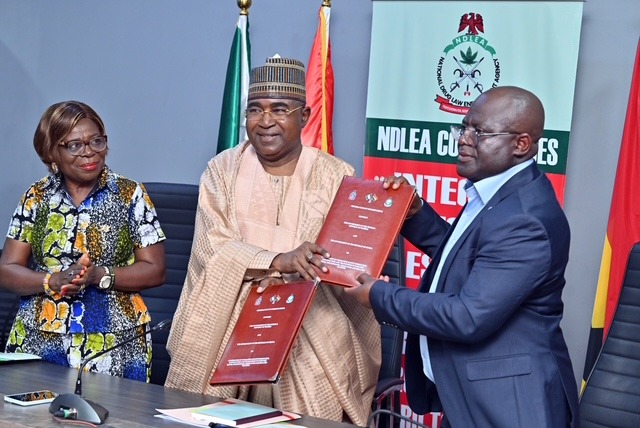
One of the highpoints of the visit is the signing of a Memorandum of Understanding between NDLEA and NACOC, which Marwa described as the most significant milestone of the engagement.
“This agreement on combating the illicit production of psychotropic substances, their precursors, and related money laundering activities provides us with a legal and operational roadmap. It moves our relationship from informal consultation to a structured, aggressive, and unified front against drug barons”, he noted.
In his remarks, Brig Gen Mantey noted that “Nigeria has consistently played a leading role within our region, and Ghana holds that leadership in the highest regard. In many respects, we look to Nigeria as an elder brother. Beyond that, the relationship between our two countries is deeply valued. It is grounded in shared history, mutual respect, and a common commitment to peace, stability, and sustainable development across West Africa.”
He said over the years, the bond has translated into strong cooperation, with the partnership between NACOC and NDLEA standing as a clear and practical reflection of that enduring relationship. “For us therefore, this visit is not about beginning a new chapter, but about strengthening an already solid foundation, deepening trust, exchanging experiences, and making our collaboration even more practical and impactful.”
Buttressing the significance of the new partnership with NDLEA, Brig Gen Mantey said the drug menace across the region continues to evolve in both scale and complexity, hence the urgent need to collaborate with partners. “We are witnessing increasingly sophisticated trafficking methods, a greater reliance on maritime corridors, and a growing presence of synthetic drugs. At the same time, the linkages between drug trafficking and other forms of organised crime are becoming more pronounced, with implications for security, governance, and public health.
“In Ghana, we are also observing a gradual shift. While we have historically been considered largely a transit point, there is now a growing domestic dimension, both in terms of drug use and internal distribution. This makes the challenge more complex, but also more urgent. And it reinforces a simple but critical reality: no single country can effectively address this threat in isolation.
We came with a clear purpose: to exchange experiences, strengthen our institutional relationship, and identify practical areas for enhanced cooperation, particularly in operations, training, and intelligence sharing. Across all these areas, our focus goes beyond activities alone. We are especially interested in the systems behind the successes, the structures, policies, and operational models that ensure consistency, efficiency, and long-term impact.
“We are especially pleased to bring our discussions on bilateral cooperation to a meaningful conclusion with the long-awaited signing of the Memorandum of Understanding marking a significant milestone toward deeper collaboration and a stronger partnership between our two agencies.
“For us, this MOU must go beyond a symbolic gesture. It should translate into real, measurable outcomes, stronger intelligence sharing, more coordinated joint operations, structured training exchanges, and closer day-to-day collaboration between our respective teams. The true value of this partnership will be defined not by what we sign, but by what we implement.”
He expressed sincere appreciation to the NDLEA leadership for its hospitality, openness, and the spirit of cooperation that has characterised the engagement., adding that “We value this relationship deeply and remain fully committed to strengthening it even further.”
Present at the ceremony was the acting Ghanaian High Commissioner in Nigeria, Dr. Gladys Mansa Yawa Feddy Akyea and other senior officials of the High Commission as well as other members of the NACOC delegation and top management staff of NDLEA.