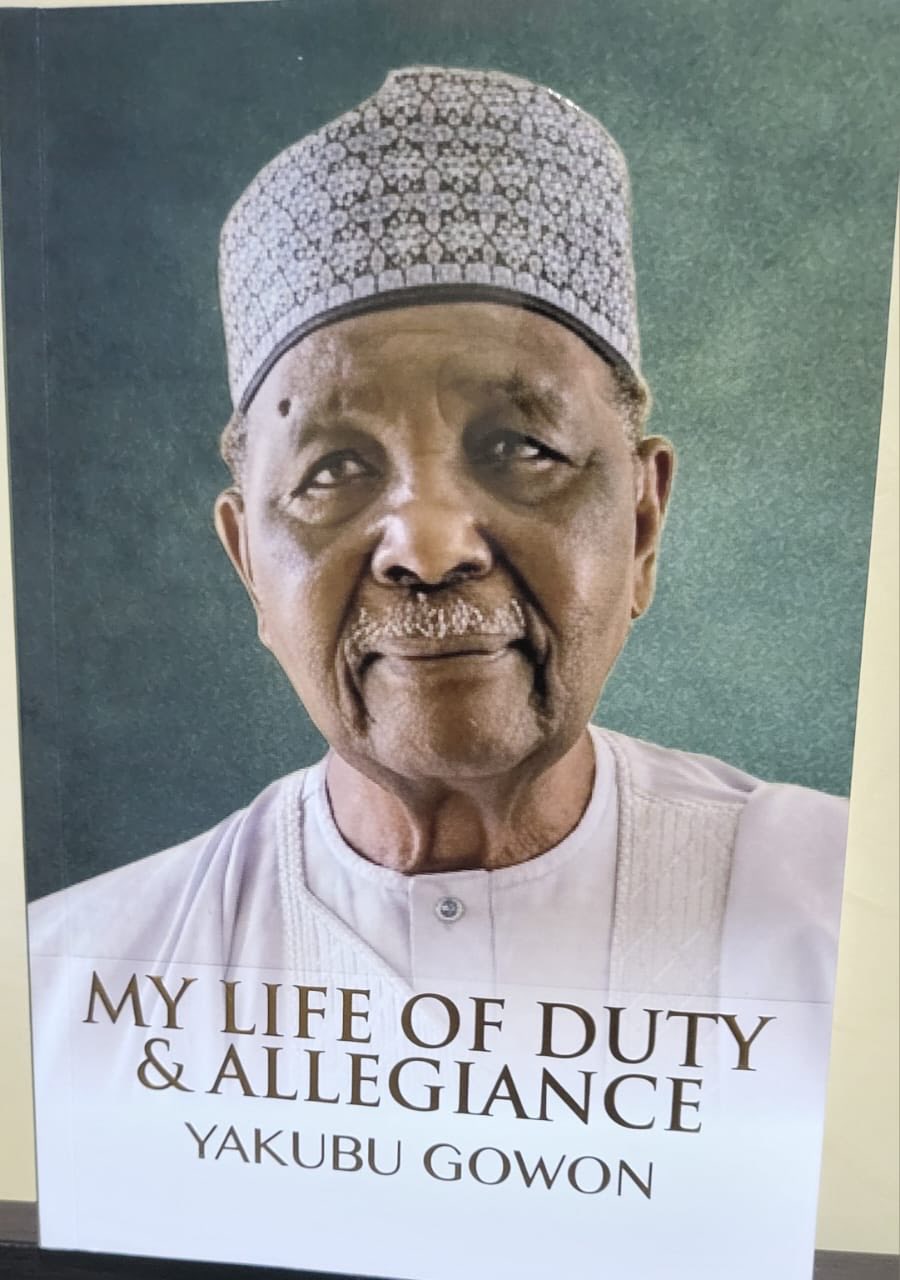

A review by Lindsay Barrett

The story of the growth of Nigeria from independence in 1960 to its present day manifestation as Africa’s most populous nation, sometimes regarded as a symbol of unrealized potential for the entire continent, cannot be properly told without mention of the problematic years of 1966 to 1975 under the leadership of General Yakubu Gowon. This remarkable saga is uncovered in nearly 900 pages and 36 chapters of narration by the General in a revelatory autobiography entitled MY LIFE OF DUTY AND ALLEGIANCE which has been published in Nigeria in the 92nd year of his life.
The anecdotal accuracy and emotional intimacy of the story as narrated by the author exposes the demonstrably devout example of his attitude of humility and honesty towards governance that was unfortunately truncated with his overthrow. It is therefore very relevant that readers of the book should contemplate why the narrative commences not with his accession to power but with a reflective chapter on his removal from office. This formula of each chapter dealing with a critical event or decision in the course of his life and professional career in a random rather than chronological order enhances the historical veracity of the book and thus improves the intellectual experience that the narrative delivers.
In outlining his early life as the son of a pioneering native missionary evangelist in Northern Nigeria Gowon relates a very articulate recollection of colonial youth and education. This upbringing helped to build the character and attitudes that inspired his responses towards national service as a military officer later in life. The values of moral veracity and respect for order that he inculcated early in life were profoundly activated when he was persuaded to accept the responsibility for the restoration of discipline in Nigeria’s armed forces as a result of a coup d’etat in the planning of which he had played no part.
An interesting consequence of a careful reading of this book is the eventual conclusion that some of the most important outcomes of well-known historical events might have occurred because of irresponsible human attitudes. General Gowon’s recollections of the breakdown of the Aburi Accord, which led to the outbreak of the Nigerian civil war is a case in point. His views might still generate disagreement from some quarters, but they are enunciated with convincing detail from his side, and the issue although one of the most controversial historical events narrated in the book is presented with extremely credible memorial recollection.
The author’s main desire appears to be to provide a fair and objective depiction of major experiences of his life as a leader building a post-colonial leadership role in West Africa which he inherited almost by accident. In order to tell this incredible story believably General Gowon and his editors have cobbled together a comprehensive document based largely on his reminiscence of events and dilemmas that are related in memorable anecdotes that are very convincing and vitally positive aspects of this remarkable book. As a consequence, the story told is replete with reflections, opinions and revelatory information about public affairs that are interpreted in terms of intimacy and lack of confidentiality that would be considered unusual in most political leader’s biographies.
As a result, his comments on major issues such as the founding of ECOWAS and the conduct and conclusion of the Nigerian civil war as well as his views on the need for representative governance provide valuable insights for conscientious readers. The work coming at this late stage of his life also provides General Gowon with the opportunity to philosophise extensively on the depth of his devotion to the Christian faith that shaped his youth and now strengthens his belief in humanity’s future.
The lasting impression that one gets from a thorough reading of this voluminous work is that the author always advocated decency in human relationships in the formulation of government policy. He endured serial violations of his principles in the pursuit of his objectives. The tale of how he was hounded and accused of having plotted a coup while in exile, and how he was eventually cleared of the accusation, which he denies ever having been true, is a cautionary one. Anecdotes about his personal life, especially the deep and compassionate alliance that his marriage to his wife Victoria has proven to be, confirm the genuinely solid devotion to decency in human relations at the core of his being.
Narrating the events and circumstances that led to the civil war, the ultimate duty of command of his entire career he expresses the belief that his duty was to restore peace and unity rather than to record a triumphant conquest. His adherence to these standards explains his relationship to the cerebral academic Ukpabi Asika who accepted his request to represent the Igbo ethnic group’s resistance against secession and persuade them to return to unity in the spirit of No Victor No Vanquished at the end of the civil war, which was the ultimate achievement of the Gowon story that has now been told by the man who lived it.