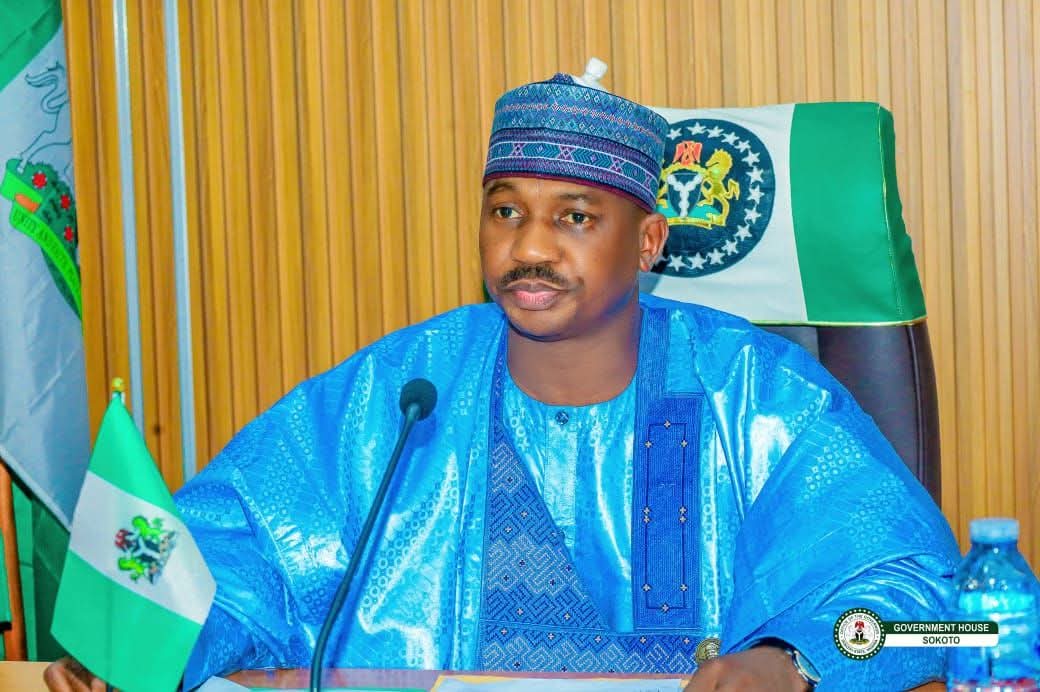

By Emmanuel Ado

“I claim to be a simple individual liable to err like any other fellow mortal. I own, however, that I have humility enough to confess my errors and to retrace my steps.” Mahatma Gandhi
When Governor Ahmed Aliyu knelt at the APC state secretariat in May 2026 and appealed to Senator Aliyu Wamakko to forgive him for any issue that might have arisen between them in the course of governing the state, urging him to see it as a matter between a father and his son rather than as the actions of a sitting governor, political pundits naturally rushed to attach different meanings to the moment. In their eagerness to decode the politics behind the now-viral scene, many overlooked the deeper truth it revealed about the governor himself. For some, it was immediately interpreted through the narrow lens of electoral calculations and political strategy.
Others, however, saw something entirely different: An act of humility rooted not in political convenience but in personal values. Humility is not a trait that can be activated during politically sensitive moments and discarded once the cameras are gone. It is an expression of character, a reflection of a person’s internal values and upbringing. What many witnessed in that moment was not a carefully choreographed political performance but a glimpse into the personality of a leader who appeared willing to place relationships, respect, and human connection above the weight of office.
It is equally important to stress that the apology was not limited to Senator Aliyu Wamakko alone. Governor Aliyu also extended the same spirit of contrition to the people of Sokoto State. He openly acknowledged that in his determination and haste to accelerate development across the state, he might, knowingly or unknowingly, have offended some people along the way. That admission is significant because it broadens the context of the entire episode and weakens the argument that it was merely tied to electoral considerations. If the intention was solely political positioning ahead of future contests, there would have been little reason to extend such a broad appeal beyond the political sphere. Instead, his words conveyed an awareness that governance, no matter how well-intentioned, often produces difficult decisions and unintended consequences. The willingness to publicly acknowledge this is itself revealing.
To understand why a sitting governor would profusely apologize to his people despite the prestige and authority of his office, one must understand were Governor Aliyu is coming from. The governor has never concealed the fact that he remains, in every sense, a man deeply rooted in his home environment and who has never forgotten where he is coming from. In fact, his most unscripted and cherished moments are times spent among them. Apart from his brief stint as Executive Secretary of the Police Equipment Fund, virtually his entire life and public service career have been closely tied to Sokoto State.
Part of Governor Aliyu’s success stems from a lifetime rooted in Sokoto State’s social and political landscape. Having grown up and lived among the communities he now leads, he deeply understands their rhythms and has maintained relationships that long predate his election. This lifelong connection explains his comfort in stepping outside the rigid, formal boundaries of high office; for someone whose identity has been entirely shaped by the people, his humility is simply a continuation of who he has always been.
This deep-seated maturity is also the secret behind the remarkable political stability Sokoto State enjoys today. Across Nigeria, the political landscape is littered with what analysts often describe as the wreckages of “godfather-and-godson” relationships—alliances that frequently implode the moment a protégé assumes office. Yet, while other regions suffer through bitter, state-paralyzing feuds, Senator Aliyu Magatakarda Wamakko and Governor Ahmed Aliyu have managed their relationship with exemplary mutual respect and emotional intelligence. By maintaining a frictionless bond, they have proved that political mentorship can work, and have successfully insulated the state from the destructive infighting that has derailed governance in other states.
There is an enduring misconception that political mentorship—popularly known in Nigeria as the “godfather and godson” relationship—is inherently negative because of the distorted version of mentorship. Leaders are selected not for their competence or capacity to serve, but for their perceived loyalty and willingness to be controlled. In reality, mentoring mirrors a proven global model where seasoned leaders identify promising talent, recognize their drive and shared values, and actively invest in their development to build lasting legacies. This constructive approach is precisely what defines the iconic partnership between Senator Aliyu Magatakarda Wamakko and Governor Ahmed Aliyu, proving that healthy political guidance is essential for a stable leadership.
Their journey began with the rare art of Senator Aliyu Wamakko spotting leadership qualities in the young Aliyu and bringing him into public service by appointing him as a commissioner. By taking him under his wing, Wamakko built on Aliyu’s foundational administrative experience and institutional knowledge required for high-stakes statecraft. This long-term investment and mentorship is ultimately bearing fruit—not just in Aliyu’s successful election as Governor, but in his spectacular performance, demonstrating how strategic leadership grooming benefits the state.
The Aliyus are quietly telling Nigerians that all that matters is the underlying motive. For Senator Wamakko, it was all about nurturing a protégé to lead independently, and for Governor Aliyu, the relationship has been most beneficial in the performance of his duty. And he has, both in private and public, shown his deference to his benefactor. By grounding their alliance in mutual respect, they have transformed what could have been a potentially volatile political dynamic into a partnership that works, proving that when mentorship works, the state reaps the rewards.
Over his last three years in office, Governor Aliyu has quietly made it a personal duty to show up on the doorsteps of the bereaved—not as a governor surrounded by heavy security, but as a grieving brother and son sitting on the bare mats alongside mourning fathers, looking them in the eyes and sharing in their grief. The same compassion is evident in his unannounced visits to families blessed with newborns. Such grounding moments serve as a constant reminder to him that power is transient, reinforcing the urgent task of building a Sokoto State where no one dies simply because they cannot access medical care, and where every newborn child—a vital stakeholder in the future—can grow up to attend schools equipped with the proper facilities.
Governor Aliyu’s accessibility and willingness to apologize for any perceived shortcomings are not a new persona adopted for the 2027 governorship election; they are the continuation of a character forged long ago. In and outside the Government House, he is known for breaking protocol to share a joke or a warm laugh with career civil servants and domestic staff who have known him since his days as a young commissioner under Senator Wamakko. He has refused to allow the office to distance him from the people, maintaining the same approachable, relatable demeanor that has always characterized his life.
This grounded nature is most visible in how he relates to those who knew him long before the trappings of power. The Commissioner for Lands, Housing, Survey, and Town Planning, Barrister Nasiru Aliyu Dan Tsoho, was his classmate; yet, the shift in power dynamics has done nothing to alter a deep brotherhood forged when they were youngsters. Similarly, the State Accountant General, Alhaji Umar Ahmad Balarabe, was once his lecturer. Upon assumption of office, conventional political wisdom dictated that having served under the previous Aminu Tambuwal administration, he would be replaced.
Instead, Governor Aliyu retained him, defying expectations and demonstrating the profound, enduring respect of a student for his teacher. Ultimately, Governor Aliyu is a leader fiercely loyal to his roots; he has flatly refused to allow high office to distance him from his friends or his constituency, maintaining the exact same approachable, relatable demeanor that has always characterized his life.
So, when Governor Ahmed Aliyu knelt before his political mentor and also asked his constituents for forgiveness for any perceived shortcomings, it was not an act of political weakness or a calculated display for the 2027 elections. Rather, it was the raw expression of the exact same philosophy that drives him to sit on a simple mat with grieving families, share a genuine smile with a proud mother, or break protocol to joke with the domestic staff in the government house. It takes a rare, commendable level of self-awareness and emotional grounding for a leader of his stature to openly acknowledge his humanity—to state clearly that he is bound to make mistakes, and ready to ask his people for grace.
As Sokoto looks toward the 2027 governorship election, armchair political analysts will undoubtedly continue to debate the optics and the supposed strategies behind the “Sokoto Kneel.” But for the ordinary citizens, the civil servants, and the lifelong friends who truly know Governor Aliyu, there is no hidden agenda. They do not see a calculated political persona; they see a leader who, despite holding the highest office in the state, has remained undeniably, unalterably down to earth.