
By Tony Perkins, April 17, 2026

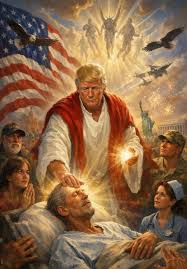
President Trump’s recent Truth Social post, which seemed to depict him as the Great Physician (though he later deleted it), serves as a reminder of why the biblical principle often described as the separation of church and state still matters.
Yes, I support that separation and always have. Let me explain.
When many on the Left invoke “separation of church and state,” they often mean the exclusion of God from government, suggesting He has no authority or place in public life. That is neither biblically grounded nor practically sustainable. As the Apostle Paul writes in Romans 13:1, “there is no authority except from God, and the authorities that exist are appointed by God.” Civil leaders get their authority from God.
And when governments deny or marginalize that truth, they ultimately erode the very foundation of their own authority.
Scripture draws a clear boundary. Civil leaders are not to assume roles or authority that belong to God or His ordained institutions, yet spiritual leaders are responsible for upholding those boundaries.
We see this vividly in 2 Chronicles 26 during King Uzziah’s reign. Israel was flourishing, economically strong, militarily secure, and territorially expanding. But success gave way to pride:
“But when he [Uzziah] was strong, he grew proud, to his destruction. For he was unfaithful to the LORD his God and entered the temple of the LORD to burn incense on the altar of incense. But Azariah the priest went in after him, with eighty priests of the LORD who were men of valor, and they withstood King Uzziah and said to him, ‘It is not for you, Uzziah, to burn incense to the LORD, but for the priests…’” (2 Chronicles 26:16-18).
He entered the temple to burn incense, a duty reserved exclusively for the priests. Azariah and 80 priests confronted him, warning that he had crossed a line established by God. Uzziah’s judgment was swift and sobering.
The lesson is clear: God establishes both authority and limits. The king was not above those limits. The priests had the authority not only to defend the sacred but also to confront and correct the king. To do so, they needed to be independent of the king.
This is the proper understanding of the separation of church and state: civil leaders must not assume spiritual authority, and spiritual leaders must not surrender moral authority. It protects the church’s independence so it can speak truth to power — and it restrains the state from assuming spiritual authority it does not possess.
Dr. Martin Luther King Jr. captured this well in his sermon “A Knock at Midnight”: “The Church must be reminded that it is not the master or the servant of the state, but rather the conscience of the state. It must be the guide and the critic of the state, and never its tool. If the Church does not recapture its prophetic zeal, it will become an irrelevant social club without moral or spiritual authority.”
When any political leader is portrayed — or allows himself to be portrayed — in explicitly messianic terms, a line has been crossed. And when the Church remains silent, the line fades.
The question is not merely about one post or one moment. It is whether the church will faithfully serve as the conscience of the state — or quietly surrender that role.
Because when the line disappears, both institutions suffer — and truth is the casualty.
Tony Perkins, President of Family Research Council and Executive Editor of The Washington Stand, is a Christian Post (CP) Op-Ed Contributor