

Weekend Trust Page 3 Comment, Saturday October 4, 2025

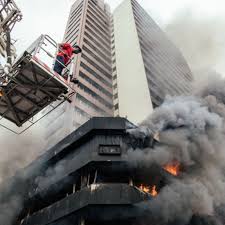
Penultimate Tuesday’s fire outbreak at Afriland Towers, a six-storey building located on Broad Street, Lagos Island, reignited concerns on the preparedness and limitations in Nigeria’s emergency response and regulatory agencies. United Capital Plc, which occupies the third and fourth floors of the building, lost six of its employees while the Federal Inland Revenue Service (FIRS) lost four. During the incident, many occupants were reportedly trapped, with some jumping from windows to escape the inferno.
The Lagos State Government said the towers’ incident was triggered by a spark from inverter batteries located in the basement of the building. And as the incident laid bare, the deaths could have been avoided if the emergency services – National Emergency Management Agency (NEMA), Federal Fire Service (FFS), Nigeria Security and Civil Defence Corps (NSCDC), Nigeria Police, State Fire and emergency and regulatory services had acted differently.
Yet, emergency response incidents – fires, building collapses, and natural disasters – have always been with us. In 2024 alone, Lagos State recorded over 1,600 emergency incidents, including more than 340 truck-related crashes and over 260 fire outbreaks, many in multi-storey commercial buildings.
In the first five months of 2025, Nigeria recorded at least 25 major market fire incidents. They include the October 1 early morning fire which destroyed about 26 shops at the very busy Bariga Market in Lagos.
On February 18, 2025, fire at the Talata Mafara Central Market in Zamfara State killed three people with 50 sustaining injuries, while on February 23, over 100 shops were destroyed in a fire at the Central Market in Gusau, Zamfara capital. Sokoto Kara Market, a major hub for the sale of grains, suffered two major fire outbreaks in 2025, destroying at least 560 shops.
Lagos alone saw 19 building collapses in the first half of 2025, with over 350 deaths nationwide in the past decade. In February 2024, a shopping plaza under construction in Onitsha, Anambra State, collapsed, killing at least six people and trapping others in the debris. Another building collapsed in Awka, the state capital, a disturbing pattern. In Plateau State, 22 students died in school collapse as victims were trapped in dense rubble.
Generally, these incidents and deaths are blamed on prevention failures by supervisory agencies and “slow and inadequate” response by emergency services. Across the country, accusations of slow response time from internal building safety officers to the statutory emergency services are frequent, resulting in some people sometimes jumping from burning buildings. The situation is exacerbated by lack of adequate equipment and due enforcement of safety precautions in designing, constructing and managing the buildings. For example, as of 2024, Lagos reportedly has just one functional crane for major rescue operations. Thus, the state relies more on private contractors for crucial equipment, which can be unreliable in high-risk emergencies where every second counts.
This is compounded by outdated and inefficient fire and other emergency vehicles, limited access to water especially hydrants, insufficient aerial ladders for high-rise buildings, including under-staffing and low response time, with the average being between 30-60 minutes especially in a congested city like Lagos, instead of few minutes.
Most worrisome is that most public buildings and markets lack sprinklers, smoke detectors or clear emergency exits. In fact, a 2023 study in Abuja found that 70 per cent of shopping malls lack functional emergency response requirement systems.
Therefore, Daily Trust calls for stricter enforcement and mandatory compliance with all building and fire requirements by regulatory bodies. We also insist that in case of non-compliance, serious punishment for individual officials and agencies responsible for negligence or lack of oversight should be imposed according to specifications. Moreover, all regulations should be backed with relevant federal and state laws for enhanced enforcement of safety standards. The laws should also include mandatory improved funding for emergency response, and severe penalties for violations by developers and construction professionals.
We also call for improved power supply as fires have been traced to power supply issues. It is instructive that the fire at the Afriland Towers started from the batteries in the inverter room, a reminder that if there is stable supply of electricity, there would have been no need for such installation and regular use.
There should also be installation of fire/smoke detectors in buildings as most victims of fire die due to smoke inhalation and suffocation. Every building must have adequate fire safety system with regular maintenance and equipment, exit points, and an alarm system with regular emergency drills in order to acquaint all users of available safety measures. Also, all buildings must have internal first responder officials and equipment, meaning that for each high-rise building, there must be fire management facility personnel.
We also advice that every room in high-rise building must be equipped with safety rope ladder that can be deployed instantly in case of emergency. Such ladders, compact and easy to use, can provide individuals with a personal means of escape, independent of malfunctioning lifts or overcrowded stairwells.
In addition, the Federal Fire Service (FFS), in conjunction with their state counterparts, should implement nationwide audit of both public and private buildings and ensure that all safety standards are enforced while erring facilities are sanctioned. The FFS should also help in training facility managers just as it strengthens partnerships with regulatory agencies.
Specifically, there should also be diligent implementation of 2026 National Building Code regulations to ensure uniform standards for structural integrity, fire safety measures, electrical installations and accessibility alongside the seven regulatory bodies of the built environment.
Most importantly, we at Daily Trust call for synergy among emergency response agencies in order to minimise duplication of duties, wasted resources, and reduced efficiency which could weaken the overall response. There should be clear and crucial mandates towards the development and execution of integrated national strategies.
Our offices, market areas and other public places should not become death traps. Towards this, all professional and regulatory bodies must rise up and plug regulatory services failure. Human errors should not be allowed to destroy the nation’s human and material resources. There should be no issue of compromise of safety standards.