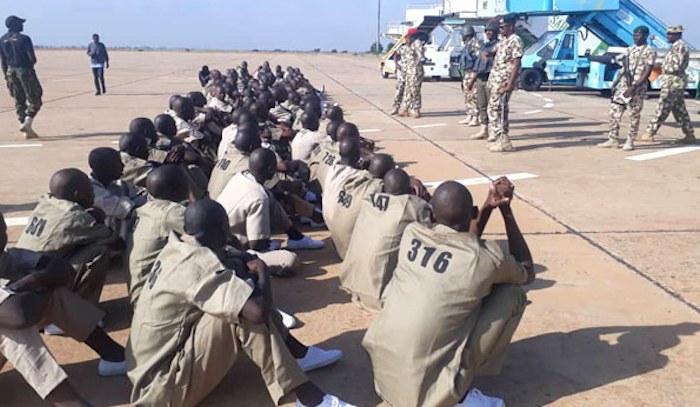

The leading coalition opposition party, African Democratic Congress (ADC), on Sunday criticised the Federal Government’s De-radicalisation, Rehabilitation and Reintegration (DRR) programme whereby hundreds of former terrorists are reabsorbed into society, saying the approach shows a dangerous slide of softness towards terrorism.

The ADC, in a statement by its Spokesperson, Bolaji Abdullahi, said recent comments by government officials describing insurgents as brothers and prodigal sons, alongside plans to reintegrate them, reveal a troubling misunderstanding of the threat posed by terrorism.
The DRR, is being executed under Operation Safe Corridor (OPSC), which was set up in 2015 for the deradicalisation, rehabilitation and reintegration of surrendered and repentant terrorists.
But the ADC insists that terrorism should not be treated lightly or compared to family disputes, warning that responding to such a serious threat with soft language and policies that appear to favour rehabilitation over justice is dangerous.
According to the party: “Terrorism is not a family dispute. It is not a moral metaphor. It is a sustained and organised campaign of violence against the Nigerian state and its people. To respond to such a threat with language that softens its meaning, and policies that appear to prioritise rehabilitation ahead of accountability, is not compassion. It is weakness.”
The ADC said the government’s current approach does not reflect a clear or effective security strategy but smacks of a confused and potentially harmful effort.
“What Nigerians are witnessing is not a coherent security strategy. It is, at best, confusion dressed up as policy; at worst, a dangerous policy of political appeasement,” the party stated.
It further argued that there is a contradiction in the government’s position, stating: “On one hand, the government claims to be prosecuting a war against terror.
“On the other, it appears eager to reintroduce insurgents, who have waged a war against the Nigerian state, into society without first establishing clear processes for justice, without transparent standards for determining genuine repentance, and without credible safeguards to protect the communities they are being returned to.
“This is not balance. It is a dangerous failure of judgement and political accommodation taken too far.”
The party raised concerns over the lack of transparency in the reintegration plan.
They questioned how individuals are selected and whether proper safeguards are in place to protect communities.
“Nigerians do not know who has been investigated, who has been prosecuted, or on what basis individuals are deemed safe for reintegration,” it said.
The ADC also pointed out that there is no clarity on how the individuals would be monitored after their return, or whether affected communities were consulted.
The party warned that reintegrating former fighters without justice could send the wrong message to victims and even encourage further violence.
“The ADC believes that terrorism must be treated as what it is: an existential threat to the Nigerian state. Our approach will be rooted in clarity, accountability, and competence. Those who have committed grave crimes will face the full weight of the law, because justice is not optional in a society governed by laws.
“Above all, the safety of Nigerian communities will come first, and the voices and rights of victims will be central to any national response.
“Nigeria cannot afford mixed signals in a fight that demands discipline and resolve. National security is not a guessing game, and it is not a space for sentiment to override judgement. It requires leadership that understands the stakes and is prepared to act with firmness and clarity,” the party added.