
By Luke Onyekakeyah

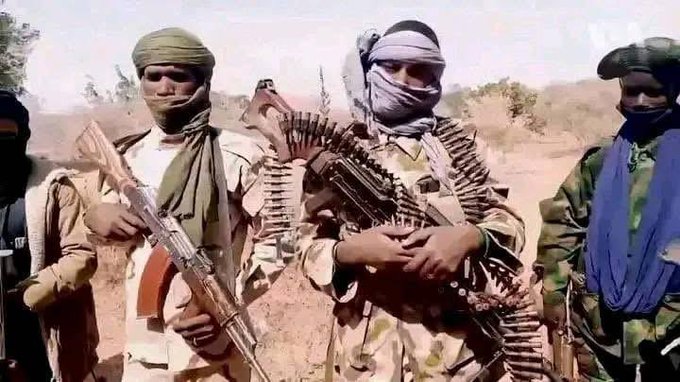
What happened in Oyo State on Friday May 15, 2026 has added yet another frightening dimension to the escalating terror and banditry across Nigeria. As the situation worsens, no part of Nigeria is safe given the audacity of the terror gangs in their operation. Has the government given up on the bloody terror pervading the country, one would like to ask?
According to reports, armed bandits attacked three schools in Oriire Local Government Council in Oyo State, where they abducted students, teachers, and staff. Oyo State Government confirmed 18 primary pupils, 7 secondary students, and 7 teachers were abducted.
One of the abducted teachers, Mr. Michael Oyedokun, a Mathematics teacher at Community High School, Ahoro-Esinele, was brutally beheaded. A video released on Telegram on Sunday May 18 showed him bound and beheaded.
The video caused widespread outrage. The other victims are still in captivity. Abducted principal Mrs. Rachael Alamu and teacher Temitope released videos pleading for help.
Oyo State Government said security operatives hit IEDs planted by the abductors in Old Oyo National Park. Some soldiers, Amotekun Corps, and vigilantes reportedly died. The wounded personnel are receiving treatment.
So far, six suspects linked to the kidnapping have reportedly been arrested. Governor Seyi Makinde said Oyo is using both kinetic and non-kinetic approaches to rescue the victims. President Tinubu, on his part, condemned it as barbaric and ordered a technology-driven rescue mission led by the IGP. He also urged the National Assembly to fast-track state police legislation.
The Odua Peoples Congress (OPC) called on SW governors to declare a state of emergency and equip vigilantes, hunters, and groups like OPC to enter the forests and flush out the bandits and terrorists.
This attack marks a southward spread of school-targeted banditry that was previously concentrated in the North-West and North-East. The schools hit were rural and had minimal security presence.
Groups like CAIDOV are demanding immediate implementation of the Safe Schools Initiative in Oyo: trained school security, early warning systems, and rapid response units. The main concern now is the safety of the remaining 45 pupils and teachers still in captivity.
“Reign of terror” is how many Nigerians describe the surge in banditry and armed violence across the North-West, North-Central, and parts of the North-East since 2020.
Similarly, banditry refers to armed gangs operating mostly in Zamfara, Katsina, Sokoto, Kebbi, Kaduna, Niger, and Benue. Their main activities include mass kidnappings for ransom, schools, highways, villages. Some 857 people were reportedly abducted in H1 2025 alone.
Attacks on farms and villages – gangs raid, kill, burn homes, and impose “harvest taxes. Highway ambushes: Roads like Abuja-Kaduna, Birnin Gwari, and parts of Niger have become “killing fields”. Security forces are targeted: Some 17 soldiers were killed in Kaduna/Niger while more than 40 Civilian JTF were reportedly killed in Zamfara in H1 2025.
The scale of killings is horrendous. For instance some 2,266 people were killed by bandits/insurgents in H1 2025 as against 2,194 for all of 2024. Nigeria ranked 6th most terrorized country globally on the 2025 according to Global Terrorism Index. Some 10,217 were reportedly killed by armed groups in northern Nigeria between 2023 and May 2025.
In parts of Isa and Sabon Birni LGAs in Sokoto, lawmakers say “bandits are in charge” and traditional rulers can’t act. There is economic stranglehold: Bandits impose “protection fees” and “harvest taxes” on farmers. Transporters pay ₦5,000-₦50,000 per trip to move goods to Abuja in what is called a “bandit tax” on food.
Displacement and hunger pervade the areas. Thousands have been displaced, farms abandoned, markets shut. Analysts call it “agricultural terrorism” because it is driving food inflation. New groups like Lakurawa and Mahmuda emerged in 2025, specializing in hit-and-run raids and extortion in Sokoto, Kebbi, Niger.
It is pertinent to as what’s driving this scourge of insecurity. Ungoverned spaces: Vast forests and border areas with little state presence. Illegal mining nexus: Over 60 percent of bandit camps in North-Central are within 10km of illegal mining sites. Gold, lithium, and lead are used to buy weapons.
Ransom economy: An estimated $1.66m was reportedly raised from kidnappings between July 2024 and June 2025. Jihadist links: ISWAP/ISIL commanders like Abu-Bilal al-Minuki coordinate with local gangs. Experts say jihadists and bandits are increasingly cooperating.
Weak policing: Analysts argue that banditry is a law enforcement problem first, and the police are overstretched. That explains why state police is necessary to go into the nooks and crannies of the state and local government areas.
The military claimed to have killed more than 3,100 terrorists in 2024, rescued over 1,600 hostages. In September 2025, they announced the killing of ISWAP commander Abu-Bilal al-Minuki in Lake Chad. The Federal government classified bandit gangs as terrorists to give military more legal cover. Government created Mining Marshal Corps in 2025 to secure mining sites, but stretched thin. Some 128 hostages were reportedly rescued in Zamfara in Aug 2025.
The impacts of terror on daily life include farmers abandoned fields and food inflation hit 12.12 percent in March 2026, according to reports. Education is affected. Schools in remote areas attacked. Some 42 schoolchildren were reportedly abducted in Borno in September 2025. Displacement of communities as whole villages emptied. Some politicians can’t visit their constituencies.
Banditry, it would be recalled evolved from cattle rustling and land disputes into a self-funding criminal economy tied to kidnapping, illegal mining, and taxation. Military strikes kill commanders, but the economic incentives keep recruiting new fighters.
Is there a way of breaking this cycle beyond military operation? As it were, military operations can kill commanders and disrupt camps in short-term, but it won’t break the cycle unless you cut off the three factors that keep banditry aliven namely money, recruits, and ungoverned space.
First kill the money pipeline .Banditry runs like a business. If the cash and recruitment dries up, the operations could stop. Thus, disrupt illegal mining; crack down on ransom payments, and attack the “bandit tax” economy:
Second, make the social contract functional in rural areas. Create state police or community policing units; ensure justice at the local level, especially over land, grazing; provide basic services as a security tool – chools, clinics, water points in vulnerable LGAs. Bandits can’t tax and recruit easily where the state shows up with services, not just soldiers.
Third, break the recruitment pipeline. Banditry pays better than farming in many areas. Change the math. Provide targeted livelihood programs; counter-messaging: Bandits sell themselves as protectors against cattle rustlers and corrupt officials. Local leaders and religious figures need to delegitimize that narrative with consistent, visible action.
Fourth, fix the cross-border and inter-gang problem. Nigeria, Niger, Chad, Cameroon need real-time intel on forest corridors. The Lake Chad operation that killed al-Minuki worked because of months of ISR with AFRICOM. Border communities are the first line of intel. Give them radios, early warning systems, and a direct line to security forces.
Political will to treat terror and banditry as organized crime, not just “security” Right now it’s split between police, army, NSCDC, vigilantes. No one owns it. There should be one command structure per state: A state-level task force with police lead, military support, and civilian oversight. Clear rules of engagement and accountability for abuse.
Prosecute collaborators: Politicians, traditional rulers, and businessmen who fund or protect bandits need to face charges. Otherwise it’s just whack-a-mole. Truth is government knows what to do to end terror and banditry in Nigeria if they really want.
Dr. Onyekakeyah, former member of The Guardian Editorial Board and is a Public Affairs commentator