
By Abubakar Adam Ibrahim

Alhaji Ahmed Joda nodded and looked up at the ceiling for a brief moment of reflection. It was sometime in 2017. After reading one of my books, he had asked for an audience. We met in one of the offices of the Yar’adua Centre after he had chaired an event. Our conversation soon segued into history, conflict and national unity. When I asked him why men like him chose not to publish their accounts of the events that led to the Civil War and what informed the decisions they made, he paused to reflect.
Alhaji Ahmed Joda was one of the preeminent public administrators in the country and during the Nigerian Civil War was one of the most powerful men in the country as a leading public servant famously known as ‘Super-perm-sec’. After reflecting, he said they thought of the war as a conflict among brothers and once it was over, there was no need to gloat or recount stories that would only keep the wounds open. They thought it was best to put the events behind them and rebuild the nation. It was obvious that was a mistake, as he himself admitted in that conversation.
The silence has meant that the accounts of those events have been largely onesided with the Biafran perspective now mainstreamed. There is nothing wrong with that. The Federalists inexplicably chose to disregard the claim that history is told by the victors. Until more recently perhaps with the likes of Gen. Paul Tarfa (A Profile in Courage, 2007, revised 2017), and Gen. Ibrahim Babangida (A Journey in Service, 2025) publishing their memoirs.
Would I have loved to read an account of the war by Emeka Ojukwu? To understand the tensions that guided his decisions and why he stayed in that war longer than it was necessary? Absolutely. Unfortunately, we would never have that, which is a shame, considering Ojukwu was an Oxford-trained historian.
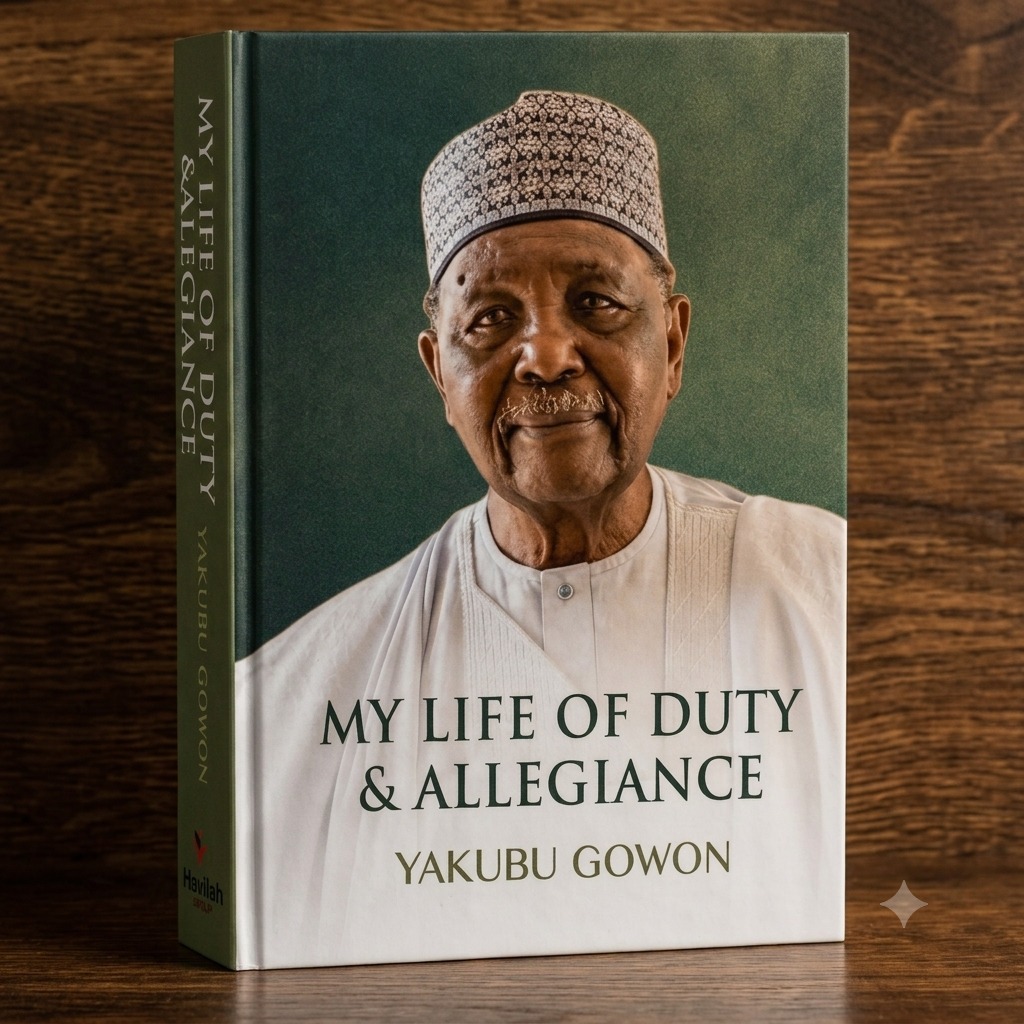
However, the chieftain on the other side, General Gowon, has finally delivered his memoir, My Life of Duty and Allegiance (2026), thanks to providence and a long life. And when one of the most prominent figures in that war publishes a memoir, it is a significant event.
I have read many accounts of that war including the memoirs of General Babangida and General Tarfa, whose book is partly personal reflection on his role in the crisis that engulfed Nigeria from the January 1966 Coup, in which his actions helped foil the coup. Most historical accounts often overlook the fact that the decision by the then Lieutenant Tarfa of the Federal Guards to lock up some errant soldiers on the night of January 15, 1966, would directly foil the plot of his commanding officer, Major Donatus Okafor, one of the principal coup plotters. Perhaps if Tarfa had not published his book, this key detail would have been lost in the grand narratives of those events. Yes, Gen. Tarfa glossed over certain key moments, like his involvement in the July 1966 coup and his duties in the Civil War, but he did throw some crumbs.
Gowon’s new memoir? Well, that is an interesting proposition. I have not had access to it so I have not read it yet. Do I expect it to give all the details about what happened in that crucial period, and the period after, where he governed the country and perhaps, as some would say, laid the foundations for the culture of governmental profligacy that has become entrenched in the country following the post-war oil boom? Would he be very sincere about allegations of his complicity in the killing of General Murtala Mohammed, for instance, in a failed counter-coup? That is hard to imagine and there are many reasons.
First, there is such a thing as the heroic narrative bias, where memoirists unconsciously reshape their past to fit the classic hero’s journey archetype. The author often downplays their own failings and flaws to portray themselves as overcoming great trials. There is also the cognitive bias that allows authors rewrite past actions to make them look wiser and more deliberate. With the passage of time, 60 years since the war at least, retrospective hindsight bias is a real possibility. The loss of records through the 1975 Coup that ousted him from office, and some fire incidents in the years after, means that the almost 900-page memoir relies a lot on General Gowon’s recollection. At 91, the reliability of one’s recollections, especially of crucial minutiae, becomes questionable.
If there is one person whose account is worth hearing, it is Gowon whom providence chose and placed at the strategic intersection to be both a witness and conductor of Nigeria’s destiny. From the young soldier with no political motivation, completely unaware of the July Coup that, through fate and providence, swept him into power, to the war he had to oversee, and his nine years in power, surpassed only by Obasanjo’s cumulative total, Gowon had seen it all and is still here to tell his story.
I do not expect any earth-shattering revelations from this memoir. To expect that would be a failure to grasp the public persona of General Gowon, which has always been circumspect. It is what defined and made him the acceptable choice to lead the country following the events of July 29, 1966, it is what informed his most famous quote, “No victor, no vanquished.” It is this disposition, which has served him well in life, that might just prevent this memoir from providing all the answers Nigerians desire.
Not too long ago, we have had General Ibrahim Babangida’s memoir to throw some light on some of those critical periods in nation-building. Naturally, it was met with some outcry over some of the claims that many people disputed or found completely implausible. The concept of retrospective hindsight bias often leads to historical revisionism.
The mistake that generation made – and there were many – was to not contextualise the events that have shaped Nigeria sooner. If they had, it would have helped Nigerians process what has now become historical trauma and the dogmas that subsequent generations have been nurtured on. Generations that have been raised on a singular narrative that they have so internalised that at this juncture, inviting them to review the alternative facts of these events and that period would be met by fierce resistance.
So, while silence is golden, and in some instances, more eloquent than poetry, these long silences were neither golden nor eloquent. They had given the wounds of a nation an extended lifespan and left subsequent generations broken and angry over things they never fully grasped.
When the late Ahmed Joda reflected that their decision not to speak about those events was a mistake and, in hindsight, they should have handled things differently, it was a realisation that should have some significance, even if members of that generation are all on the threshold of memory. It is great to see that some members of that generation decided to unburden themselves at dusk. It may move the needle a little or not at all. But for posterity, it may count.
Abubakar Adam Ibrahim can be reached via abubakaradam@dailytrust.com Twitter: @Abbakar_himself Whatsapp: 08020621270