

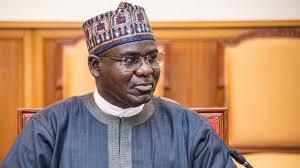
Former Chief of Army Staff (COAS), Lieutenant General Tukur Yusuf Buratai (rtd) has called for a fundamental overhaul of Nigeria’s security architecture, warning that the country’s military-led approach to internal security has become unsustainable as insecurity can only be tackled through a whole-of-society strategy.

Buratai, who spoke while delivering a lecture in Abuja, said Nigeria has reached a critical crossroads where traditional military responses have become not only unsustainable but counterproductive.
“The key threat is the system behind the gun not the gun itself,” Buratai said, arguing that insurgents and bandits are products of wider criminal ecosystems sustained by financiers, logistics networks, recruiters and ideological influences.
He warned that military victories would remain temporary unless those underlying structures were dismantled.
“Killing a hundred bandits at once achieves nothing if the money pipeline remains open; it is simply mowing the grass.”
Buratai also raised concerns over military’s increasing involvement in domestic security operations, saying it is currently engaged in more than 32 routine internal operations across the country.
He argued that the situation has weakened the armed forces’ primary responsibility of defending Nigeria against external threats at a time when instability in the Sahel continues to worsen.
“The military is dangerously overstretched,” he said, adding that prolonged deployment for policing duties has eroded its conventional war-fighting capability.
The retired army chief identified multiple security threats confronting the country, including Boko Haram and ISWAP insurgency in the North-East, banditry and mass kidnappings in the North-West, separatist agitations in the South-East and oil theft in the Niger Delta.
Despite their regional differences, he said the crises share common root causes, including poverty, youth unemployment, underdevelopment, weak infrastructure and ungoverned spaces.
“No quantity of bullets can resolve these drivers because they are not military problems; they are failures of governance and economics that manifest as violence,” Buratai said.
To address the challenges, Buratai proposed a five-point security reform agenda centred on military professionalisation, police reform, technological innovation, development and stronger coordination among security institutions.
He recommended that the armed forces gradually withdraw from routine internal policing while the Nigeria Police Force expands to about 1.5 million personnel in line with the United Nations’ recommended police-to-population ratio.
“Without this fundamental rebalancing, the military will remain perpetually distracted from border defence, maritime threats and the spillover from the Sahelian crises.”
Buratai also advocated what he described as a “whole-of-society approach,” involving government institutions, civil society groups, traditional rulers, religious leaders, the media and young people.
“This is not a rhetorical flourish. State security apparatuses alone cannot reach every village, forest or urban slum where recruitment and radicalisation occur.”
On economic development, the former army chief argued that security and development are inseparable.
“Building roads, railways, social services and job-creating industries is not an adjunct to security policy; it is the security policy.”
Buratai further proposed establishing a National Defence Innovation Fund through public-private partnerships to finance research in cyber security, drone technology, satellite communications and renewable energy while strengthening local defence manufacturing.
He said investments in such technologies would have civilian applications, including agricultural mapping and telemedicine.
On tackling criminal networks, Buratai urged the government to stop negotiating with armed groups and instead target the financial and logistical structures sustaining them.
“Bandits do not survive on weapons alone; they depend on intricate support networks of financiers, illegal miners, ransom negotiators and local informants.”
He called for coordinated action by agencies including the Nigerian Financial Intelligence Unit (NFIU), Economic and Financial Crimes Commission (EFCC), Department of State Services (DSS) and the Nigeria Extractive Industries Transparency Initiative (NEITI) to identify and prosecute conflict financiers.
Buratai also proposed creating a National Emergency Command with direct presidential authority in conflict zones and advocated state policing alongside properly vetted community vigilante groups integrated into national security structures.
In reviewing the lecture, Hassan Abdullahi, former Director (Army) at the Ministry of Defence, described the presentation as “one of the most coherent doctrine-level security blueprints ever articulated by a former Chief of Army Staff.”
Abdullahi praised Buratai’s analysis for shifting the national conversation beyond calls for more troops, adding: “The lecture’s greatest strength lies in its diagnostic accuracy. By framing insecurity as a national emergency rather than a regional or tactical problem, Buratai elevates the conversation beyond parochial interests.”
He, however, noted that the proposals lacked clear implementation timelines, cost estimates and stronger accountability mechanisms for emergency security structures and state-level vigilantes.
“There is no fiscal estimate or timeline for the 1.5 million police target or the National Defence Innovation Fund,” Abdullahi observed, adding that implementation would require sustained political commitment.
He added that Buratai’s lecture represents “a landmark contribution to Nigeria’s security literature” and could help transform the country’s security strategy if backed by funding, oversight and political will.
“Buratai’s paper is a call to restructure, not merely to reinforce,” Abdullahi wrote. “The question is no longer what to do, but whether Nigeria has the collective will to do it.”




Sanitise The Mining Sector Now