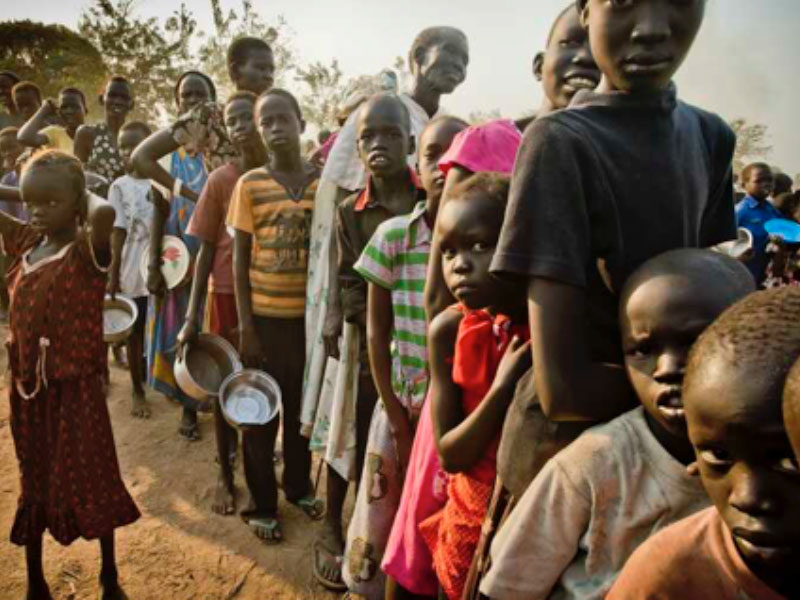

Reactions has trailed the report by the United Nations food agency, World Food Programme (WFP), that at least 17 million people across nine conflict-hit States in Northern Nigeria are facing severe hunger as a result of persistent insecurity, mass displacement, economic hardship, climate-related shocks, and declining humanitarian funding, warning that they were driving acute food insecurity to its worst level in nearly a decade.

The WFP, in a statement, said the latest food security analysis showed the number of people facing crisis, emergency, or catastrophic hunger had risen by almost 2 million from previous projections.
Speaking on the report, WFP regional director for West and Central Africa, Kinday Samba, noted that violence was spreading across a wider area and forcing people from their farmland, underlining the deepening humanitarian cost of insecurity in Nigeria where Islamist insurgents in the Northeast and armed gangs in parts of the north have displaced communities, kept farmers from their fields and restricted aid access.
Reacting to the UN revelation, the Civil Society Legislative Advocacy Centre (CISLAC) has expressed deep concern over the latest warning by the United Nations World Food Programme (WFP) that northern Nigeria is experiencing its worst hunger crisis in nearly a decade.
The executive director of the Civil Society Legislative Advocacy Centre (CISLAC) who is also head of Transparency International (TI) Nigeria, Auwal Musa Rafsanjani, said the alarming development is not merely a humanitarian emergency; it is a stark indictment of the country’s governance failures and the inability of successive interventions to address the structural drivers of poverty, insecurity, and food insecurity.
“Hunger on this scale undermines human dignity, weakens national security, fuels social instability, and threatens sustainable development,” he said.
The CISLAC boss said the civil society organisation is particularly concerned that continued attacks by insurgents, bandits, and other armed groups have displaced farming communities, disrupted agricultural production, destroyed livelihoods, and restricted humanitarian access to vulnerable populations.
“Combined with soaring food prices, inflation, unemployment, and shrinking household incomes, millions of Nigerians are being pushed deeper into extreme poverty.
“Equally troubling is the significant reduction in humanitarian assistance caused by global funding shortfalls. While international partners have played an important role in responding to the crisis, Nigeria cannot continue to depend primarily on external humanitarian support to feed its citizens. Food security is fundamentally a governance responsibility that requires sustained domestic commitment and accountable public investment,” he added.
CISLAC therefore called on the federal government and affected state governments to urgently implement coordinated emergency and long-term measures to avert a worsening catastrophe.
It particularly demanded “immediate expansion of food assistance and nutrition programmes for the most vulnerable households, especially women, children, internally displaced persons, and persons living with disabilities: restoration of security in farming communities to enable displaced farmers to safely return to their lands and resume agricultural production; increased investment in climate-resilient agriculture, irrigation infrastructure, extension services, and rural development to reduce dependence on rain-fed farming.g
It called for a transparent and accountable management of all food security interventions, ensuring that public resources and humanitarian assistance reach intended beneficiaries without diversion or political manipulation.
CISLAC further called for strengthened social protection programmes that cushion poor households from rising food prices and economic shocks as well as greater budgetary commitment to agriculture, nutrition, and rural livelihoods in line with national development priorities and regional commitments.
The civil society group also urged the National Assembly to exercise stronger oversight over food security policies, agricultural spending, emergency interventions, and security sector allocations to ensure public resources translate into measurable improvements in citizens’ welfare.
“Beyond emergency interventions, Nigeria must confront the underlying governance challenges driving recurring humanitarian crises. Persistent corruption, weak institutions, insecurity, poor budget implementation, policy inconsistency, and inadequate investment in rural communities continue to erode the country’s resilience against food shocks.
“The current crisis should serve as a wake-up call. No nation can achieve peace, economic prosperity, or democratic stability while millions of its citizens suffer from hunger and malnutrition. Protecting Nigerians from hunger is not charity—it is a constitutional obligation and a fundamental measure of accountable governance,” it said.
CISLAC called on all stakeholders—including government institutions, development partners, civil society organisations, the private sector, and humanitarian agencies—to work collaboratively towards building a food-secure, peaceful, and resilient Nigeria where every citizen has access to adequate, nutritious, and affordable food.
Declare State Of Emergency on Hunger, Don Tells FG
A political scientist and lecturer at Nnamdi Azikiwe University, Dr Christian Okeke, has urged the Federal Government to declare a state of emergency on hunger, warning that Nigeria’s worsening food insecurity has reached alarming proportions and requires immediate, coordinated intervention.
Okeke made the call while reacting to the latest report by the World Food Programme (WFP), which highlighted the growing prevalence of hunger in Nigeria and other countries facing food insecurity.
Speaking on the report, the university lecturer described the country’s rising hunger index as a national calamity that should not be ignored.
“The high index on hunger is expected and should be seen as a calamity deserving of a declaration of emergency to reduce it,” he said.
According to him, the worsening food crisis is driven by a combination of insecurity, poor social welfare programmes and economic policies that have deepened poverty and reduced the purchasing power of millions of Nigerians.
He argued that Nigeria’s deteriorating position in the Global Terrorism Index has continued to affect agricultural production, disrupt livelihoods and discourage economic activities, thereby worsening food insecurity across many communities.
Okeke lamented the absence of sustainable poverty-reduction programmes by both the Federal Government and state governments, noting that vulnerable households continue to struggle with declining incomes and limited access to economic opportunities.
“The escalation is expected in view of the worsening records of Nigeria in the Global Terrorism Index and the lack of sustainable programmes at the national and sub-national levels to provide better lives for the poor through improved access to funds and household income,” he stated.
He further blamed the country’s economic hardship on recent policy decisions, including the removal of fuel and electricity subsidies, rising inflation and increasing unemployment, saying the measures have placed additional pressure on already struggling families.
The political scientist also criticised the implementation of socio-economic reforms associated with the Bretton Woods institutions, arguing that the policies have intensified poverty and contributed to rising crime across the country.
“The poverty condition has been worsened by the removal of subsidies on petroleum and electricity, the high inflation rate, increasing unemployment, as well as the unfortunate implementation of the Bretton Woods institutions’ socio-economic recommendations, which have driven crime levels to an all-time high,” he said.
Okeke expressed concern that Nigeria failed to achieve the United Nations Millennium Development Goal of ending hunger by 2015 and warned that the country could miss the target again under the Sustainable Development Goals (SDGs) if urgent measures are not taken.
“It was worrisome that Nigeria did not meet the UN Millennium Development Goal on ending hunger by 2015 and is likely again to miss the target under the Sustainable Development Goals,” he said.
Describing the WFP report as a fresh warning, Okeke urged political leaders at all levels to treat the findings as a wake-up call by implementing policies that would boost agricultural production, create jobs, tame inflation and strengthen social protection programmes for vulnerable Nigerians.
“The damning WFP report should, again, serve as a wake-up call to leaders in the country,” he added.
He stressed that tackling hunger requires deliberate investments in agriculture, improved security, employment generation, and targeted interventions to raise household incomes.
According to him, failure to address the underlying causes of food insecurity could further undermine national stability, weaken economic growth and worsen the living conditions of millions of Nigerians.
Written with reports from Leadership